
Cash Conversion Cycle: Calculate Yours and Free Up Cash (Worked Example)
A full cash conversion cycle example from one hypothetical shop's accounts, showing how 45 fewer days in the cycle frees 127,500 in cash, and which lever does the most.
On this page
- Key takeaways
- The cash conversion cycle formula and its parts
- Cash conversion cycle example from a set of accounts
- Three levers to shorten the cycle, and how much cash each frees
- How to calculate your cash conversion cycle, step by step
- Monthly cash conversion cycle checklist (copy this)
- Decision rules: which lever to pull first
- Common mistakes when calculating the cash conversion cycle
- Edge cases: cash retail, cash on delivery, marketplaces and manufacturing
- Cash and card retail
- Cash on delivery through couriers
- Marketplace payouts
- Manufacturing and assembly
- Seasonal stock builds and supplier prepayments
- How to do this in Cash Flow Inventory
- Frequently asked questions
- What is a good cash conversion cycle?
- Can the cash conversion cycle be negative?
- Should I use 365 or 360 days?
- How does the cash conversion cycle differ from the operating cycle?
- How can I reduce DSO without upsetting customers?
The cash conversion cycle (CCC) is the number of days your cash is tied up between paying for stock and getting paid by customers. The formula is CCC = DIO + DSO − DPO. A business that holds stock for 90 days, collects from customers in 35 days and pays suppliers in 30 days has a 95-day cycle. For 95 days, it is funding its own trade.
The formula is the easy part. The useful part is knowing which balances to take from your accounts and which period to divide by. You also need to know how much cash each day of improvement actually frees, because a day is not worth the same amount in every part of the cycle.
This page works through one complete example from a set of accounts. It costs three levers in real cash and shows the before-and-after cycle in a chart. You also get a copy-ready monthly checklist, the mistakes that distort the number, and how to pull every input from Cash Flow Inventory.
Key takeaways
- CCC = DIO + DSO − DPO. Use average balances, not just the year-end figure, and match each balance to the right flow: cost of sales for stock and suppliers, sales for customers.
- One day of DIO or DPO is worth one day of cost of sales in cash. One day of DSO is worth one day of sales, which is usually more.
- In the worked example, the cycle drops from 95 to 50 days and frees 127,500 in cash. Most of that comes from slow stock and slow collections, not from squeezing suppliers.
- Strip sales tax out of receivables, and use the cash-receipt date for cash-on-delivery and marketplace sales. Otherwise your DSO is overstated.
- Track the cycle monthly from the same reports, using the same method each time. The trend matters more than any single figure.
The cash conversion cycle formula and its parts
The cycle has three parts. Each one is a balance from your balance sheet turned into days of activity from your profit and loss.
CCC = DIO + DSO − DPO
DIO (days inventory outstanding) = average inventory ÷ cost of goods sold × days in period
DSO (days sales outstanding) = average trade receivables ÷ credit sales × days in period
DPO (days payables outstanding) = average trade payables ÷ cost of goods sold × days in period
Average balance means the opening balance plus the closing balance, divided by two. If your stock swings a lot during the year, average the month-end balances instead. Our guide to the average inventory formula covers both versions.
DIO is the same measure as the inventory conversion period. It is also 365 divided by your inventory turnover.
Strictly, DPO should divide payables by purchases, not cost of sales. Most small businesses use cost of sales because it sits on the profit and loss, and that is fine if stock levels are fairly stable. Whichever you choose, use the same one every month.
Cash conversion cycle example from a set of accounts
Here is the full calculation for one year. Every figure comes from either the profit and loss for the year or the balance sheet at the start and end of the year.
Example: a shop selling kitchenware online and to a handful of trade customers on 30-day terms. This is a hypothetical business with a 365-day year. Amounts are in dollars, but the method works in any currency.
| Line | Opening | Closing | Average | Flow for the year | Per day | Days |
|---|---|---|---|---|---|---|
| Inventory | 240,000 | 210,000 | 225,000 | Cost of sales 912,500 | 2,500 | DIO 90 |
| Trade receivables (excl. sales tax) | 130,000 | 150,000 | 140,000 | Sales 1,460,000 | 4,000 | DSO 35 |
| Trade payables (excl. sales tax) | 70,000 | 80,000 | 75,000 | Cost of sales 912,500 | 2,500 | DPO 30 |
| Cash conversion cycle | 90 + 35 − 30 = 95 |
The arithmetic is as follows. DIO is 225,000 ÷ 2,500 a day = 90 days. DSO is 140,000 ÷ 4,000 a day = 35 days. DPO is 75,000 ÷ 2,500 a day = 30 days.
The cash tied up in the cycle is 225,000 + 140,000 − 75,000 = 290,000. That is what the shop’s own money or its overdraft is funding at any moment.
Three levers to shorten the cycle, and how much cash each frees
Each lever moves one part of the cycle. To turn days into cash, multiply the change in days by the daily figure that part is measured against:
- For DIO and DPO, that is daily cost of sales.
- For DSO, it is daily sales.
That is why the same number of days is worth different amounts in different places.
Example continued: the kitchenware shop’s three changes
| Lever | Days before | Days after | Change | Value of one day | Cash freed | New average balance |
|---|---|---|---|---|---|---|
| 1. Stock: clear slow lines, reorder smaller and more often | DIO 90 | DIO 70 | −20 | 2,500 | 50,000 | Inventory 175,000 |
| 2. Customers: invoice on dispatch, chase from day 1 overdue | DSO 35 | DSO 25 | −10 | 4,000 | 40,000 | Receivables 100,000 |
| 3. Suppliers: agree 45-day terms with the two largest | DPO 30 | DPO 45 | +15 | 2,500 | 37,500 | Payables 112,500 |
| Total | CCC 95 | CCC 50 | −45 | 127,500 | Cash tied up 162,500 |
Check: 70 + 25 − 45 = 50 days. Cash tied up falls from 290,000 to 175,000 + 100,000 − 112,500 = 162,500. The difference is 127,500.
If the shop’s overdraft costs 12% a year (an example rate), 127,500 less borrowing saves about 15,300 in interest a year. That is before the lower storage costs and the reduced write-down risk on the stock it no longer holds.
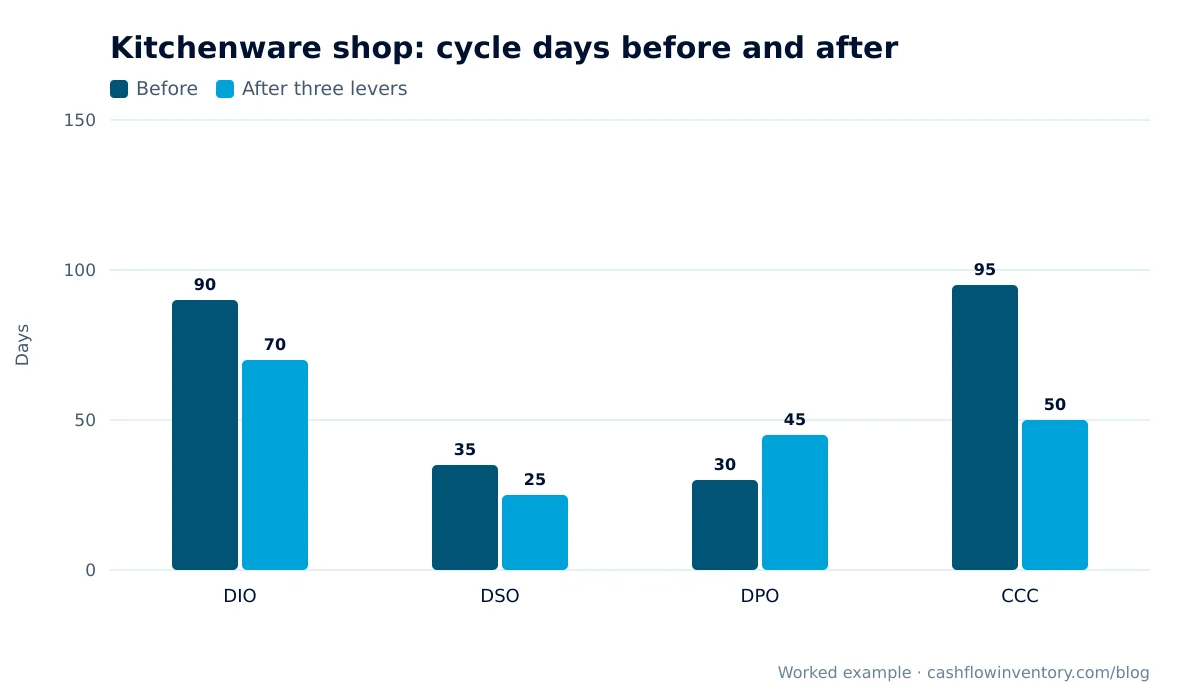
Three things stand out in this example:
- Stock frees the most cash. The 20 stock days free 50,000. That is the lever this shop controls fully, without asking anyone.
- Collection days are worth the most per day. Ten days of DSO free 40,000, because each collection day is worth sales value, not cost.
- Suppliers are the least valuable and most fragile lever. Fifteen supplier days free the least, and they depend on goodwill you may need later.
For more on why stock is usually the biggest lever, see the relationship between cash flow and inventory control.
How to calculate your cash conversion cycle, step by step
- Pick the period. A full year is the most stable choice. A quarter (90 or 91 days) shows change faster. Use the actual number of days in the period every time.
- Take sales and cost of sales for that period from your profit and loss, both excluding sales tax.
- Take inventory, trade receivables and trade payables from the balance sheet at the start and the end of the period. Average each pair.
- Clean the balances. Remove sales tax from receivables and payables. Exclude loans to staff, deposits, tax balances and payables that are not for stock or direct costs.
- Calculate daily figures. Divide sales by the days in the period, then do the same for cost of sales.
- Work out DIO, DSO and DPO by dividing each average balance by its daily figure. Then calculate CCC = DIO + DSO − DPO.
- Cost each lever by multiplying the days you can realistically change by the matching daily figure.
- Put the freed cash into your forecast week by week, not as one lump. Stock runs down as you sell and reorder less, so the cash arrives gradually. A cash flow forecast and budget shows when it actually arrives.
Monthly cash conversion cycle checklist (copy this)
- Run the profit and loss for the last 12 months to date. Note sales and cost of sales, both excluding tax.
- Run the balance sheet at today’s date and 12 months ago. Note inventory, trade receivables and trade payables.
- Remove sales tax from receivables and payables, and remove anything that is not trade.
- Calculate DIO, DSO, DPO and CCC, and write all four into the same sheet as last month.
- If DIO rose by more than 5 days, list the 20 lines with the most stock value and the fewest sales.
- If DSO rose by more than 3 days, list every customer more than 15 days overdue and who is chasing each one.
- If DPO fell, check whether you are paying early by habit or have lost terms with a supplier.
- Record one action per lever, with an owner and a date.
Decision rules: which lever to pull first
- Start where a day is worth the most and costs the least to change. For most product businesses that is stock, then collections, then suppliers.
- Cut stock by line, not across the board. Rank products by stock value divided by monthly units sold. The top of that list is where the 20 days are hiding.
- Do not trade a stockout for a few days of DIO. Lost sales cost margin, and a shorter cycle on a smaller business is not a win. Keep safety stock on fast sellers. Our inventory turnover guide covers how to balance the two.
- Fix the invoicing date before you chase harder. If invoices go out three days after dispatch, that is three days of DSO you can remove without a single reminder. Automating reminders helps with the rest; see automating accounts receivable processes.
- Never stretch suppliers past agreed terms. Negotiate longer terms openly, ideally in exchange for volume or reliability.
- Take early-payment discounts when you can fund them. Terms of 2/10 net 30 mean giving up 2% to keep the cash 20 more days. That is roughly 2 ÷ 98 × 365 ÷ 20 = 37% a year. It is cheaper to borrow and take the discount than to stretch the payment.
Common mistakes when calculating the cash conversion cycle
- Using sales instead of cost of sales for DIO. Stock is carried at cost. Dividing it by sales makes DIO look shorter than it is by your margin.
- Mixing periods. Dividing a year-end balance by one month of sales, or a quarter’s balance by 365 days, gives a nonsense figure. The days in the formula must match the period of the flow.
- Using only the closing balance. If you ran stock down just before year end, a closing-only DIO flatters you. Average the balances, or use month-end averages for seasonal trade.
- Leaving sales tax in receivables. Receivables include VAT or GST, but sales on the profit and loss do not. At a 20% rate, a true 35-day DSO shows as 42 days. Strip the tax out, or gross up sales by the same rate.
- Counting stock you cannot sell. Damaged or obsolete stock still on the books inflates DIO and hides the problem. Inventory should be carried at the lower of cost and net realisable value under IAS 2 Inventories, so write it down first.
- Treating the cycle as a profit measure. A shorter cycle means less cash tied up. It does not make an unprofitable product profitable. Check margins separately.
Edge cases: cash retail, cash on delivery, marketplaces and manufacturing
Cash and card retail
A shop that is paid at the till has a DSO close to zero. Card settlement still takes one to three days, so use the settlement lag as your DSO rather than zero. For these businesses, the cycle is mostly DIO minus DPO, and it can be negative. A negative cycle means suppliers are funding the stock, which is good while sales hold up and dangerous if they drop.
Cash on delivery through couriers
For COD sales, the sale is not cash until the courier remits it. That can be one to three weeks after delivery, and returned parcels never pay at all. Measure DSO from dispatch to the courier’s cash remittance, not from the invoice to the customer.
Marketplace payouts
Marketplaces hold your money until their payout cycle and may keep a reserve. Treat the marketplace balance as a receivable, and measure DSO to the date the payout lands in your bank.
Manufacturing and assembly
Include raw materials, work in progress and finished goods in inventory. A long production run adds directly to DIO. Sometimes the lever is shorter batches, not fewer purchases.
Seasonal stock builds and supplier prepayments
If you build stock for Ramadan, Eid, Diwali or the Christmas peak, an annual average hides a cycle that may run 150 days before the season and 40 after. Calculate it quarterly as well.
Deposits paid to overseas suppliers before goods ship are cash out before any stock exists. Add the deposit period to DIO, or track prepayments as a separate line, so the cycle does not look shorter than your cash experience.
Expert tip: When a lender or investor asks for your cycle, give the annual figure and the quarterly range together. “95 days, ranging from 70 to 140 through the season” tells them how big a facility you need and when. That is the question behind the question.
How to do this in Cash Flow Inventory
In Cash Flow Inventory, every document posts to the ledger as it happens, so the statements you need are always current. There is no month-end re-keying before you can calculate the cycle. The full procedure is in the financial statements guide.
- Open Finance › Reports and choose Profit and loss. Pick the period (for example, the last 12 months) and the location if you have several. Choose accrual as the method. Note sales and cost of sales.
- Use Compare with the previous period or last year to get the prior figures for your trend.
- Open Balance sheet at the start date and again at the end date. Note inventory, receivables and payables on each date, and average them.
- If a balance looks wrong, open the Trial balance or General ledger to trace it entry by entry before you trust the number.
- Use the toolbar to export to Excel and run the formulas above.
- Use Schedule to have the report e-mailed monthly, so the checklist starts with the numbers already in your inbox. A relative period such as “last month” keeps each run current.
- In Reports, type plain words such as “debtors” into the search to open the receivables report with its filters set. Then use Pin as KPI to put a figure on your dashboard as a tile.
To act on the levers:
- Collections: set each customer’s terms and credit limit, and send statements from customer management.
- Cash-on-delivery sales: hold COD invoices until the courier reports the parcel, then settle them from the cash collected, using cash on delivery settlement.
- Timing the freed cash: see when it lands with the 13-week cash forecast and what-if scenarios in the planning suite.
For general guidance on managing business finances, the US Small Business Administration’s finance guide is a useful companion.
Frequently asked questions
What is a good cash conversion cycle?
There is no universal good number, because it depends on your trade. A grocery shop paid at the till may run a negative cycle, while a distributor giving 60-day terms may run 90 days or more. Compare yourself with your own trend and with similar businesses, and aim to move the figure down without causing stockouts.
Can the cash conversion cycle be negative?
Yes. A negative cycle means you collect from customers before you pay suppliers, so suppliers are funding your stock. It is common in cash retail and subscription models. It is healthy as long as sales stay steady, but a sudden drop in sales can leave you with bills larger than your incoming cash.
Should I use 365 or 360 days?
Use the actual number of days in the period: 365 for a year, 90 or 91 for a quarter, 30 or 31 for a month. Some textbooks use 360 for simplicity. Consistency matters more than the choice, so pick one and use it every time.
How does the cash conversion cycle differ from the operating cycle?
The operating cycle is DIO plus DSO: the time from buying stock to collecting cash for it. The cash conversion cycle subtracts DPO, because supplier credit covers part of that time. The CCC is the gap you actually have to fund yourself.
How can I reduce DSO without upsetting customers?
Invoice on the day of dispatch, state the due date clearly, and send a friendly reminder before the due date rather than after it. Agree terms and credit limits up front. In the UK, businesses have a statutory right to charge interest on late commercial payments, which is useful leverage even if you rarely use it.
Work out your own cycle this month using the checklist, cost each lever in cash, and start with the one worth the most to you. If you want the profit and loss and balance sheet current every day, without re-keying, start a free trial of Cash Flow Inventory and run the numbers from your live ledger.


