Is a Bulk Discount Worth It? MOQ vs Carrying Cost, Calculated
A bulk discount pays only when it beats the cost of holding the extra stock. Here is the formula, a worked table across four order sizes, and a checklist to use before you sign.
On this page
- Key takeaways
- The bulk discount formula: discount saved vs carrying cost
- The quick break-even rule
- Worked example: four order sizes compared
- What the numbers say
- How to decide on a bulk order, step by step
- Common mistakes when judging a bulk discount
- Edge cases that change the answer
- Better payment terms with the bulk order
- Prices or exchange rates expected to rise
- Expiry dates, seasons and fashion
- Storage that runs out
- New or unproven products
- Cash you would have to borrow
- Retrospective volume rebates
- Bulk purchase checklist
- How to do this in Cash Flow Inventory
- Frequently asked questions
- How do I know if a bulk discount is worth it?
- What carrying cost rate should a small business use?
- Should I accept a supplier’s MOQ if it is more than I can sell quickly?
- Is a 10% bulk discount good?
- Does buying in bulk improve cash flow?
- Make the next bulk offer a calculation, not a guess
A bulk discount is worth it when the money you save on the unit price, plus any ordering costs you avoid, is larger than the cost of holding the extra stock for the extra months it sits on your shelf. As a quick test, if the discount percentage is bigger than your monthly carrying cost rate × the extra months of cover ÷ 2, the bigger order usually pays.
Supplier price breaks and minimum order quantities always look good on the quote. The cost of holding the stock arrives later, spread across months of rent, tied-up cash and items that get damaged or go out of date.
This page gives you the full formula and a quick break-even rule. You also get a worked example across four order sizes where every number adds up, the edge cases that change the answer, a checklist to copy, and the steps to set it up in Cash Flow Inventory.
Key takeaways
- Compare three numbers: the discount saved, the ordering cost saved, and the extra carrying cost of the larger order.
- Carrying cost has to be priced per month. A 10% discount sounds big, but it can vanish if you hold the stock for a year at 2% a month.
- Check each price tier against the next one, not only against your normal order. The biggest tier is often not the best one.
- Cash matters as much as profit. A bulk order that saves money on paper can still leave you short for rent or payroll.
- A blanket agreement can often get you the bulk price without taking all the stock at once.
The bulk discount formula: discount saved vs carrying cost
Compare the options over the same period, usually one year, and for the same number of units sold. For each order size, add up three costs:
Total annual cost = annual units × unit cost + number of orders × cost per order + average inventory value × annual carrying rate
The parts:
- Unit cost is the price at that order size. Use the landed cost (freight, duty and handling included), not the ex-works price.
- Cost per order covers the fixed cost of placing and receiving one order: admin time, a minimum freight charge, inspection and bank fees.
- Average inventory value is order quantity ÷ 2 × unit cost, for an item that sells at a steady rate. Safety stock is the same whatever size you order, so you can leave it out of the comparison.
- Annual carrying rate is the cost of holding stock as a percentage of its value. It covers your cost of money, storage, insurance, shrinkage and the risk the stock goes obsolete. Our guide to inventory carrying cost explains how to estimate yours.
The option with the lowest total wins. Written as a net benefit against your normal order:
Net benefit = discount saved + ordering cost saved − extra carrying cost
The quick break-even rule
When you only have a minute with the supplier on the phone, use this approximation:
Break-even discount % ≈ monthly carrying rate × (months of cover in bulk order − months of cover in normal order) ÷ 2
You divide by 2 because, on average, stock from an order sits for half its cover period. If the discount on offer is clearly above the break-even figure, the bulk order is probably worth it. If it is close, do the full calculation.
Worked example: four order sizes compared
Example: a shop selling stainless steel water bottles. This is a hypothetical business. It sells a steady 200 bottles a month, or 2,400 a year. Placing and receiving each order costs $40. The annual carrying rate is 24%, which is 2% a month. That rate is made up of 12% cost of money, 5% storage, 1% insurance and 6% shrinkage and obsolescence.
The supplier quotes these landed prices:
- 200 units (1 month of cover): $10.00 each
- 600 units (3 months): $9.50 each, 5% off
- 1,200 units (6 months): $9.00 each, 10% off
- 2,400 units (12 months): $8.70 each, 13% off
| Order size | Unit cost | Purchase cost (2,400 units) | Orders per year | Ordering cost | Average inventory value | Carrying cost (24%) | Total annual cost | Saving vs 200 |
|---|---|---|---|---|---|---|---|---|
| 200 | $10.00 | $24,000 | 12 | $480 | $1,000 | $240 | $24,720 | — |
| 600 | $9.50 | $22,800 | 4 | $160 | $2,850 | $684 | $23,644 | $1,076 |
| 1,200 | $9.00 | $21,600 | 2 | $80 | $5,400 | $1,296 | $22,976 | $1,744 |
| 2,400 | $8.70 | $20,880 | 1 | $40 | $10,440 | $2,505.60 | $23,425.60 | $1,294.40 |
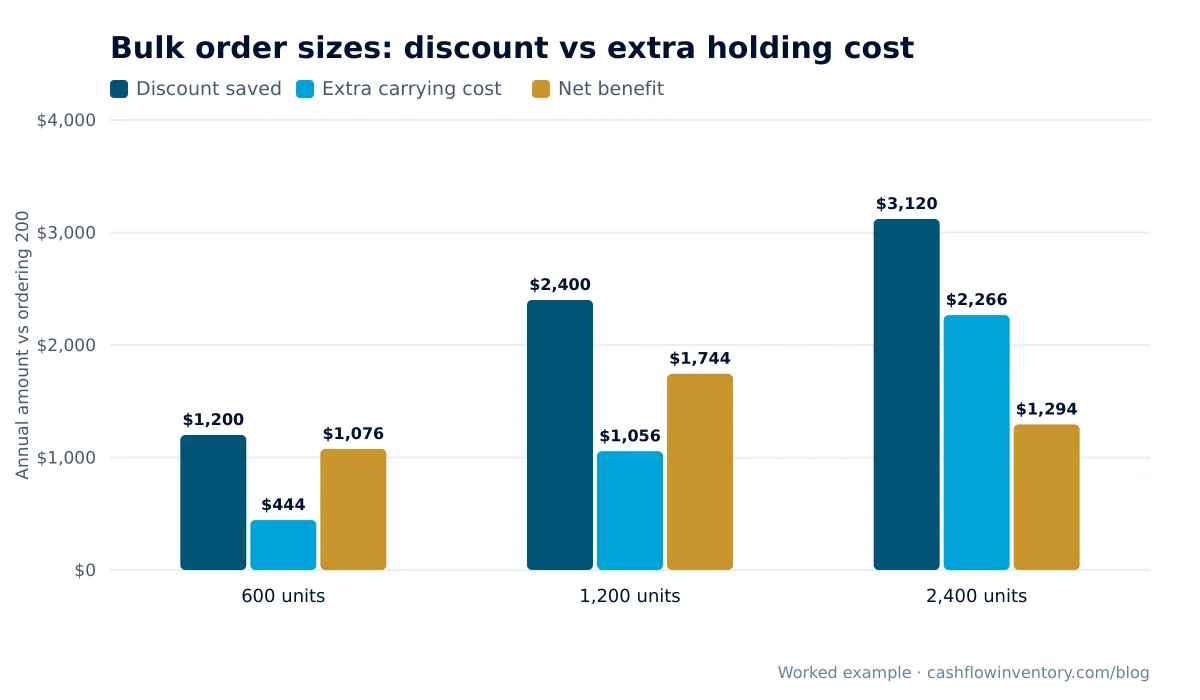
Here is how the net benefit breaks down for each bulk option, measured against ordering 200 at a time:
| Order size | Discount saved | Ordering cost saved | Extra carrying cost | Net benefit |
|---|---|---|---|---|
| 600 | $1,200 | $320 | $444 | $1,076 |
| 1,200 | $2,400 | $400 | $1,056 | $1,744 |
| 2,400 | $3,120 | $440 | $2,265.60 | $1,294.40 |
What the numbers say
All three bulk options beat ordering monthly. The 1,200-unit order is the best of them, saving $1,744 a year. The largest order has the biggest discount, $3,120, but its extra carrying cost of $2,265.60 eats most of it.
The break-even rule gives the same answer if you apply it tier by tier. Moving from 1,200 to 2,400 units cuts the price from $9.00 to $8.70, which is about 3.3%. The extra six months of cover cost about 2% × 6 ÷ 2 = 6%. The step up loses money, even though the 2,400 order still beats the 200 baseline.
Cash tells a sharper story. The 200-unit order needs $2,000 up front. The 2,400-unit order needs $20,880 on day one, and the last of those bottles sells eleven months later. Before you commit, check that order against your open-to-buy budget.
How to decide on a bulk order, step by step
- Get your real demand. Use the average monthly sales of the last 6–12 months for this item, adjusted for any season. If the item is new and has no sales history, stop here and see the edge cases below.
- Get landed prices for each tier. Ask the supplier for every price break, then add freight, duty and handling per unit. A bigger order sometimes moves you to cheaper freight, such as a full container instead of a shared one.
- Set your carrying rate. If you have no better figure, 20–30% a year is a common starting assumption for small businesses. Push it higher for fragile, fashion, tech or dated goods.
- Estimate your cost per order. Count staff time, minimum freight charges, bank or transfer fees and inspection.
- Fill in the table for each tier: purchase cost, ordering cost, average inventory value, carrying cost and total.
- Compare each tier with the next one, not only with your normal order. Stop at the tier where the step up costs more than it saves.
- Check the cash. Make sure the payment, and any deposit, fits your cash plan and payment terms without new borrowing at a higher rate.
- Check the space. Confirm the stock fits in your shelves or warehouse without renting extra room.
- Negotiate before you sign. Ask for the bulk price on a blanket order with call-offs, or for split deliveries.
For the order size with no discount involved, the EOQ calculator gives you the starting point that balances ordering and carrying costs. The economic order quantity model is the classic method behind it, and the quantity-discount version of the model is exactly the table above.
Common mistakes when judging a bulk discount
- Comparing the discount with the annual carrying rate. “10% off beats our 24% carrying rate, so no” is the wrong maths. The test is how long the extra stock sits, priced per month.
- Using the selling price for inventory value. Carrying cost is charged on what the stock cost you, not on what you will sell it for. See cost per unit for what belongs in that figure.
- Counting the discount on units you will never sell. If the 2,400 bottles include 300 that end up in a clearance bin, the “discount” on those 300 is a loss. Our guide on when to mark down or hold slow stock shows what that leftover costs.
- Leaving out freight and duty. A tier that looks 8% cheaper ex-works can be 4% cheaper landed, or more, depending on the shipping method.
- Forgetting the cash. Profit and cash are different. A bulk order stretches your cash conversion cycle by months.
- Deciding by item, not by supplier. Suppliers often set the minimum by order value across items. In that case, compare your full basket against the minimum, not one item.
Edge cases that change the answer
Better payment terms with the bulk order
If the supplier gives you 90 days to pay on the bulk order but 30 days on small ones, part of your cost of money disappears. Lower the cost-of-money part of your carrying rate for the months you are not yet paying for the stock.
Prices or exchange rates expected to rise
If you import and expect your currency to weaken, or a duty increase is announced, buying ahead protects you. Add the expected increase to the savings column, but only if you have evidence, not a hunch.
Expiry dates, seasons and fashion
For food, cosmetics, medicines, seasonal decor or fashion, the obsolescence part of the carrying rate climbs steeply after a point. Never buy beyond the cover you can sell before expiry or before the season ends, whatever the discount.
Storage that runs out
Carrying cost is not smooth. Your shelves cost the same until they are full, and then you need a second unit or a third-party warehouse. Add that step cost to the tier that triggers it.
New or unproven products
With no sales history, your demand figure is a guess. Order the smallest quantity the supplier allows, even at a higher price, and treat the extra cost as the price of learning what sells.
Cash you would have to borrow
If the bulk payment pushes you onto an overdraft or card at 20% or more, use that rate as your cost of money. That can flip a “yes” to a “no”. Basic guidance on business cash and funding is on the US Small Business Administration’s page on managing your business finances.
Retrospective volume rebates
Some suppliers pay a rebate at year end once you reach a total volume, rather than giving a discount per order. That reward does not require you to hold stock, so you can keep ordering small. Count the rebate only if you are confident of reaching the threshold.
Expert tip: Before accepting a big minimum, ask the supplier for a blanket agreement. You commit to 2,400 units over twelve months at the bulk price and call off 200 or 600 at a time. The supplier gets the volume commitment, and you get the price without the carrying cost. Many suppliers prefer this to losing the order.
Bulk purchase checklist
Copy this into your buying notes and tick each line before you sign a bulk order:
- Average monthly sales for the item, from real sales data, adjusted for season
- Months of cover each tier represents (order quantity ÷ monthly sales)
- Landed unit cost at each tier, including freight, duty and handling
- Cost per order (admin, minimum freight, fees, inspection)
- Annual carrying rate, and what goes into it
- Total annual cost per tier, and the net benefit of each step up
- Expiry, season end or model change within the cover period?
- Storage space confirmed, or extra space costed
- Payment, deposit and terms fit the cash plan
- Blanket agreement, split delivery or rebate asked for
- Approval from the person who owns the budget for orders above your limit
If carrying cost keeps winning these comparisons, the wider fix is usually faster stock turns. Our guides to inventory turnover and inventory cost reduction cover that side.
How to do this in Cash Flow Inventory
Cash Flow Inventory holds the inputs for this decision in one place: supplier price breaks, landed costs, demand and the approval of large orders. The full procedure is in the purchase orders guide.
- Turn on the parts you need. In Settings › Purchase, set Purchase process to Order → receive → bill → payment. Under What purchase documents carry, show Cost lines and Landed cost so freight and duty sit on the order. If you pay deposits on bulk buys, show Advance payments too.
- Record the price breaks. In Purchasing › Agreements & prices, add Supplier prices for each item from each quantity, with the dates they are valid, the lead time and the supplier’s own item code. When you raise an order, the order form uses the highest quantity break at or under the line’s quantity. You can try 600 and 1,200 on a draft line and see the price each one gets.
- Check demand and landed cost. Open Purchasing › Suppliers and go to the supplier’s page. Items supplied shows the purchase quantity, unit landed cost and the usual and longest lead times. The To order tab suggests what to reorder from a demand window you choose, which gives you the monthly sales figure for your table.
- Use an agreement instead of one big order. If the supplier accepts a volume commitment, record it as an Agreement in Purchasing › Agreements & prices. Each call-off is an ordinary purchase order at the agreement’s prices. It cannot take more than is left on a line or fall outside the agreement’s dates.
- Put large orders through approval. In Settings › Purchase, set Purchase order approval to Approve automatically up to an amount. Routine orders then go straight through, and bulk buys wait in the approvals centre for the budget owner to review.
- Review past bulk buys. On the supplier list, the Dead stock view shows stock that has not moved, grouped by supplier. If last year’s bulk order is sitting there, raise your carrying rate for that supplier’s goods next time.
You can see how ordering, approval and receiving fit together on the purchase order software page.
Frequently asked questions
How do I know if a bulk discount is worth it?
Add up the discount saved and the ordering costs you avoid, then subtract the extra carrying cost of holding the larger stock. If the result is positive and you can afford the cash, the bulk order is worth it. For a quick check, compare the discount percentage with your monthly carrying rate × the extra months of cover ÷ 2.
What carrying cost rate should a small business use?
Build it from your own numbers: your borrowing or opportunity cost of cash, storage, insurance, and expected shrinkage and obsolescence. If you have nothing better, 20–30% a year is a common working assumption. Use the higher end for goods that date, expire or break. Investopedia’s overview of carrying costs of inventory lists the usual components.
Should I accept a supplier’s MOQ if it is more than I can sell quickly?
Run the same calculation, treating the MOQ as the only order size on offer, and compare it with a different supplier or a smaller product range. If the MOQ covers more months than the item’s shelf life or season, decline it or negotiate a blanket order with call-offs. You can also ask for split deliveries.
Is a 10% bulk discount good?
It depends on how many extra months of stock it makes you hold. At a 2% monthly carrying rate, 10% off is worth it for an order covering up to about ten more months than your normal order. For goods that lose value quickly, it can still be a bad deal at just a few months.
Does buying in bulk improve cash flow?
Usually not. A bulk order moves cash out earlier and keeps it in stock for longer, even when it lowers your total cost. It helps cash flow only when the supplier gives longer payment terms on the larger order, or when prices are about to rise.
Make the next bulk offer a calculation, not a guess
Bulk discounts are a trade between a lower price and the months your cash sits on a shelf. Put both into the table, check each tier against the next, and confirm the cash before you sign. If you want your supplier prices, landed costs and order approvals in one place, start a free trial of Cash Flow Inventory and set up your first price breaks today.