How to Record Courier Delivery Charges and COD Fees in Your Books
Delivery charges you bill customers, courier bills and COD fees each belong in a different place in your books. This guide shows where they go, with a worked four-parcel example and a payout checklist.
On this page
- Key takeaways
- How to record delivery charges: the decision rules
- Delivery charged to the customer
- Delivery absorbed (free delivery)
- The courier’s bill for delivery
- The COD fee
- The net payout
- Worked example: four COD parcels, one courier payout
- The journal entries
- Step-by-step: recording a courier payout without double counting
- Copy-ready courier payout checklist
- Common mistakes when recording delivery charges and COD fees
- Edge cases generic answers skip
- Partial collection
- Returned parcels and the return charge
- Delivery charge paid in advance
- Lost or damaged parcels
- Rounding by the courier
- Tax on delivery charges and courier invoices
- Month-end with payouts in transit
- How to do this in Cash Flow Inventory
- Set it up once
- Day-to-day procedure
- Frequently asked questions
- Is a delivery charge income or an expense?
- Where do COD fees go in the profit and loss account?
- Should I record the courier’s net payout as sales?
- How do I record the delivery charge on a returned COD parcel?
- Is outbound delivery part of cost of goods sold?
- How do I avoid double counting courier charges?
Record a delivery charge you bill the customer as delivery income, and record what the courier charges you as a delivery expense. Do not net the two against each other. With cash on delivery (COD), the courier owes you the cash it collects, so it sits in a Courier / COD Clearing account until payout. The courier’s delivery charge and its COD fee are the expenses that explain the gap between what was collected and what reached your bank.
Most mistakes happen at the payout. The courier sends one net amount, and sellers either book that net figure as sales or record the courier’s charges twice: once per parcel and again from the statement.
This page gives you decision rules for charged and absorbed delivery, a four-parcel worked example with full journal entries, a payout reconciliation checklist, and the edge cases generic answers skip. It ends with the exact procedure in Cash Flow Inventory.
Key takeaways
- Delivery charged to the customer is income. What the courier bills you is an expense. Keep them on separate lines so you can see what delivery really costs you.
- Record revenue at the full invoice price, not the net payout. The courier’s deductions are expenses, not reductions in sales.
- Cash the courier collects belongs in a Courier / COD Clearing account until the payout lands. That account should fall back to the amount the courier still holds for you.
- Record courier charges in one place only: per parcel as a bill, or at the payout from the statement. Doing both double counts them.
- Refused parcels earn no revenue, but the courier’s delivery or return charge is still a real expense.
How to record delivery charges: the decision rules
Four amounts are involved in every courier parcel. Each has one home in your books, and most errors come from mixing two of them.
Delivery charged to the customer
If the customer pays a delivery fee on top of the product price, credit it to a Delivery income account (some businesses call it shipping income). It is part of what the customer pays you. Under revenue standards such as IFRS 15 Revenue from Contracts with Customers, it forms part of the transaction price.
Delivery absorbed (free delivery)
If you offer free delivery, there is no delivery income line. The product price carries the whole sale. The courier’s charge is still an expense, and that is exactly why you want it visible: free delivery is a cost you chose to carry.
The courier’s bill for delivery
What the courier charges per parcel, including return charges, goes to a Delivery expense (or courier charges) account. Most small businesses treat outbound delivery as a selling expense rather than cost of goods sold. Either choice can work. Pick one and stay consistent so your margins compare month to month.
The COD fee
Many couriers charge a collection fee on the cash they handle, often a percentage of the amount collected. Record it in a separate COD collection fees expense account, not inside delivery expense. It is the price of offering COD, and you will want to compare it with what prepaid orders cost you.
The net payout
The payout is not income. It settles what the courier owes you. It clears the Courier / COD Clearing account, with the courier’s charges and fees making up the difference. For the full chain from order to payout, see our guide to cash on delivery accounting journal entries.
Expected payout = cash collected − courier delivery charges − return charges − COD fees ± agreed adjustments
Delivery margin = delivery income − (courier delivery charges + return charges)
If the first formula does not equal the money in your bank, something on the statement differs from your records. Find it before you post.
Worked example: four COD parcels, one courier payout
Example: a shop selling handmade leather wallets online (hypothetical). It ships through a courier that charges Tk 60 per parcel inside the city and Tk 110 outside. Returns are charged at the same rate as delivery. The COD fee is 1% of the cash collected. One week it sends four parcels:
- Parcel A: inside the city, wallet Tk 1,200 plus Tk 60 delivery charged to the customer. Delivered.
- Parcel B: inside the city, wallet Tk 1,500 with free delivery. Delivered.
- Parcel C: outside the city, wallet Tk 1,200 plus Tk 110 delivery. The customer paid the Tk 110 in advance by mobile wallet, so the courier collects only Tk 1,200. Delivered.
- Parcel D: inside the city, wallet Tk 1,500 plus Tk 60 delivery. Refused at the door and returned.
| Parcel | Status | Product price | Delivery charged | Advance paid | Courier collects | Courier charge | COD fee (1%) | Net from courier |
|---|---|---|---|---|---|---|---|---|
| A | Delivered | 1,200.00 | 60.00 | 0.00 | 1,260.00 | 60.00 | 12.60 | 1,187.40 |
| B | Delivered | 1,500.00 | 0.00 | 0.00 | 1,500.00 | 60.00 | 15.00 | 1,425.00 |
| C | Delivered | 1,200.00 | 110.00 | 110.00 | 1,200.00 | 110.00 | 12.00 | 1,078.00 |
| D | Returned | 1,500.00 | 60.00 | 0.00 | 0.00 | 60.00 | 0.00 | −60.00 |
| Total | 5,400.00 | 230.00 | 110.00 | 3,960.00 | 290.00 | 39.60 | 3,630.40 |
The courier pays out Tk 3,630.40, which is 3,960.00 − 290.00 − 39.60. Parcel D’s Tk 1,500 and its Tk 60 delivery charge never become revenue because the sale did not happen. The wallet goes back into stock.
The journal entries
| Step | Account | Debit (Tk) | Credit (Tk) |
|---|---|---|---|
| 1. Advance for parcel C | Bank / mobile wallet | 110.00 | |
| Customer advances | 110.00 | ||
| 2. Invoices for A, B, C on delivery | Accounts receivable | 4,070.00 | |
| Sales | 3,900.00 | ||
| Delivery income | 170.00 | ||
| 3. Apply the advance | Customer advances | 110.00 | |
| Accounts receivable | 110.00 | ||
| 4. Cash collected by the courier | Courier / COD Clearing | 3,960.00 | |
| Accounts receivable | 3,960.00 | ||
| 5. Courier delivery and return charges | Delivery expense | 290.00 | |
| Accounts payable – courier | 290.00 | ||
| 6. COD fee | COD collection fees | 39.60 | |
| Accounts payable – courier | 39.60 | ||
| 7. Payout received | Bank | 3,630.40 | |
| Accounts payable – courier | 329.60 | ||
| Courier / COD Clearing | 3,960.00 |
Check: receivables net to zero (4,070 − 110 − 3,960). The clearing account nets to zero (3,960 − 3,960). The courier payable nets to zero (290 + 39.60 − 329.60). Revenue is Tk 4,070.00 and expenses are Tk 329.60. Cash received is Tk 3,740.40 (110.00 advance + 3,630.40 payout), which equals 4,070.00 − 329.60.
What the owner learns: delivery income of Tk 170 against courier charges of Tk 290 means delivery cost the shop Tk 120 net that week. Tk 60 of that was the free delivery on B, and Tk 60 was the refused parcel D.
Expert tip: if your courier charges only appear on the payout statement, you can skip steps 5 and 6. Post them inside step 7 instead: Dr Bank 3,630.40, Dr Delivery expense 290.00, Dr COD collection fees 39.60, Cr Courier / COD Clearing 3,960.00. The result is identical. What matters is choosing one method and never using both.
Step-by-step: recording a courier payout without double counting
Use this procedure every time a payout arrives, whether the courier settles daily or weekly.
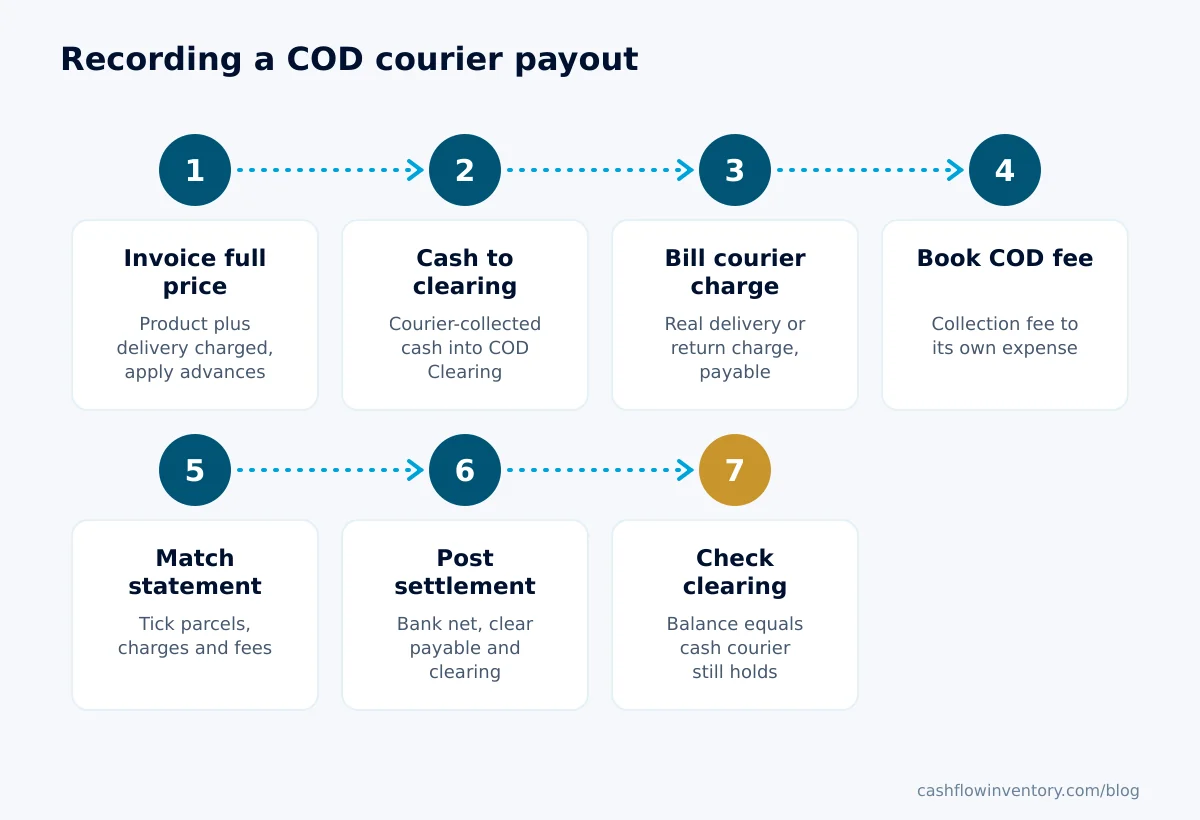
- Invoice at full price. When a parcel is delivered, invoice the product price plus any delivery charged. Apply any advance the customer already paid.
- Move the collected cash to clearing. Record the receipt against the invoice into Courier / COD Clearing, not into the bank. The courier holds that money, not you.
- Bill the courier’s real charge. Record the courier’s delivery or return charge for each parcel as a payable to the courier. Use the charge the courier actually applied, not your quoted price.
- Book the COD fee. Record the collection fee to its own expense account, against the courier payable.
- Match the payout statement. Tick every parcel on the statement against your records: collected amount, charge and fee. Apply the expected payout formula above.
- Post the settlement. Debit the bank with the net amount received, clear the courier payable, and credit Courier / COD Clearing with the gross collected.
- Check that clearing is right. After posting, the clearing balance should equal only the cash the courier has collected but not yet paid out.
Copy-ready courier payout checklist
- Every parcel on the statement exists in my records, and every delivered parcel in my records is on a statement (this one or a pending one).
- Collected amount per parcel equals invoice total less any advance.
- Courier charge per parcel matches the rate card, weight and zone. Differences are noted.
- Return charges appear only for parcels I have marked returned.
- COD fee is calculated on the base the contract says (collected amount, or invoice value).
- Courier charges are recorded once: either per parcel or at payout, not both.
- Expected payout equals the amount in the bank. Any difference is explained.
- Returned goods are back in stock and their invoices are cancelled or credited.
- Courier / COD Clearing balance equals cash still held by the courier.
Common mistakes when recording delivery charges and COD fees
- Booking the net payout as sales. Revenue then looks smaller than it is, and the courier’s costs disappear inside it. You cannot see what COD or delivery is costing you.
- Double counting courier charges. A bill per parcel plus the full charges again from the payout statement doubles your delivery expense. The courier payable goes negative, which is the giveaway.
- Netting delivery income against delivery expense. Recording only the difference hides the size of both. It also makes free-delivery promotions look cheaper than they were.
- Using your quoted price instead of the courier’s charge. If you charged the customer Tk 60 but the courier billed Tk 80 for extra weight, the expense is Tk 80.
- Recognising revenue on refused parcels. An invoice raised at booking and never reversed overstates sales and leaves a receivable nobody will pay. Our checklist on reducing fake COD orders and returns helps cut these at the source.
- Posting collected cash straight to the bank. Your bank balance then shows money you do not yet have, and the bank reconciliation never ties.
- Folding COD fees into delivery expense. You lose the number you need to decide whether to push customers toward prepayment.
Edge cases generic answers skip
Partial collection
If the customer pays less than the invoice, for example after a dispute at the door, record what was collected into clearing. Then decide the remainder: a discount allowed, a write-off, or a balance still due from the customer. Do not leave it sitting in clearing.
Returned parcels and the return charge
Cancel or credit the invoice, put the goods back into stock after inspection, and expense the courier’s return charge. If you refund a delivery charge the customer prepaid, that reduces delivery income. Our guide on returns management covers the stock side.
Delivery charge paid in advance
A delivery fee paid upfront by mobile wallet is a customer advance until the invoice exists. Applying it means the courier collects only the remainder. Revenue is still the full price.
Lost or damaged parcels
If the courier loses a parcel it collected or accepts liability for it, the amount it owes you is a claim against the courier, not a sale. Keep it in clearing or a separate courier claims receivable until it is paid.
Rounding by the courier
Some couriers book whole units of currency. A due of 1,234.50 may be collected as 1,235. Write small rounding differences to a rounding account rather than leaving cents in clearing.
Tax on delivery charges and courier invoices
Delivery you charge customers is usually taxable like the goods. In the UK, HMRC’s VAT guide (Notice 700) covers how delivery and postage charges are treated. If your courier is tax-registered, its invoice may carry VAT or GST you can reclaim. Record the tax separately from the expense. Rules differ by country, so confirm with your local tax authority or adviser.
Month-end with payouts in transit
At month end, delivered parcels not yet paid out remain in clearing. Under accrual accounting, also record charges and fees for those parcels in the month they occurred, even if the statement arrives later. US readers following ASC 606 can check the FASB guidance on shipping and handling for their policy choice.
How to do this in Cash Flow Inventory
Cash Flow Inventory follows each COD parcel until the courier reports it. When a parcel is delivered with exactly the amount booked, the app approves the invoice, records the receipt from the cash collected and puts the courier’s real delivery charge on its bill by itself. Anything different goes to a person. It works with couriers that collect the money, such as Steadfast (proven live), Pathao and RedX (tested against each provider’s sandbox). Setup guides: Steadfast courier with WooCommerce and Pathao courier integration.
Set it up once
Connect the courier and paste its webhook address and secret into the courier’s merchant panel. Then, in Settings › Sales › Approvals › Cash-on-delivery parcels, make four choices:
- Hold the invoice until the courier reports the parcel, or approve it at issue like other invoices. Holding keeps refused parcels out of revenue.
- Delivered with the right amount: approve, record the payment and settle by itself, or Review every delivered parcel before it settles.
- Close the invoice once the cash settles it in full, or leave it approved and paid.
- Record the courier’s delivery charge as a bill, settled from the cash collected, or record courier charges only at the payout. This is your double-counting switch: choose one.
Day-to-day procedure
- Book the COD parcel. Its invoice shows in Sales › Invoices › Awaiting delivery.
- Let the courier’s report arrive. Matching parcels settle by themselves.
- Open Approvals › Delivered parcels (COD) for parcels in review.
- Decide each one: approve as invoiced, accept what was collected, mark it returned, or keep it in review, with a reason.
- Open Integrations › the courier’s page › Reconcile parcels to see every parcel: due, booked, collected, the courier’s status, your price against the courier’s charge, and where it stands.
- When the courier pays out, open Accounting › Courier remittances and paste the payout statement.
- Check the amount that should reach the bank, then choose Post a settlement.
Collected cash sits in Courier / COD Clearing until the payout, and revenue stays at the full price. An advance, such as a delivery charge paid by mobile wallet, is held as a customer advance and applied when the invoice is made. Delivery bills waiting for the courier’s real charge appear in Purchasing › Bills under the Awaiting courier view.
The full walkthrough is in the cash on delivery settlement guide. For customer receipts and advances generally, see payments received and receivables.
Frequently asked questions
Is a delivery charge income or an expense?
It depends on direction. A delivery charge you bill the customer is income. A delivery charge the courier bills you is an expense. Record both in full on separate lines rather than netting them.
Where do COD fees go in the profit and loss account?
Put them in their own expense account, such as COD collection fees, usually under selling or distribution expenses. Keeping them apart from delivery expense shows what offering cash on delivery costs compared with prepaid orders.
Should I record the courier’s net payout as sales?
No. Record sales at the full invoice price when the parcel is delivered. The payout only clears what the courier owes you, and the deductions are recorded as delivery expense and COD fees.
How do I record the delivery charge on a returned COD parcel?
Cancel or credit the invoice so no revenue remains, and return the goods to stock. Record the courier’s delivery or return charge as delivery expense, because you owe it even though the sale failed.
Is outbound delivery part of cost of goods sold?
Many small businesses record it as a selling expense, which keeps gross margin about the product. Some include it in cost of sales. Either is acceptable if applied consistently. You can test both views with our gross margin calculator.
How do I avoid double counting courier charges?
Choose one point to record them: per parcel as a bill, or once from the payout statement. A negative balance on the courier payable, or delivery expense higher than the statement total, signals you have recorded them twice.
Once the clearing account, courier bills and COD fees each have their own home, every payout reconciles in minutes and your delivery margin stops being a guess. To have COD parcels settle, bill and reconcile alongside your stock and accounts in inventory accounting software built for it, start a free trial.