Cash on Delivery Accounting: Journal Entries From Order to Courier Payout
Journal entries for a cash-on-delivery sale, from the customer's advance to the courier's payout, worked through with three parcels whose numbers reconcile to zero.
On this page
- Key takeaways
- Why cash on delivery needs its own accounting
- The accounts you need for COD
- Cash on delivery journal entries, event by event
- 1. Advance received (if any)
- 2. Parcel handed to the courier
- 3. Courier confirms delivery and collection
- 4. Courier’s delivery charge
- 5. Parcel refused and returned
- 6. Courier pays out
- Worked example: one payout cycle, three parcels
- The payout check formula
- Step-by-step COD accounting procedure
- Month-end COD clearing checklist
- Common COD accounting mistakes
- Edge cases: partial collection, lost parcels, rounding and tax
- The customer keeps part of the order
- You invoice at dispatch instead of delivery
- The courier loses or damages a parcel
- The advance on a refused parcel
- Rounding
- Tax on sales and on courier charges
- How to do this in Cash Flow Inventory
- Frequently asked questions
- What is the journal entry when the courier collects cash on delivery?
- Is the COD clearing account an asset or a liability?
- How do I record the courier’s delivery charge?
- How do I account for a returned COD parcel?
- Should I record COD revenue at dispatch or at delivery?
- Why doesn’t the courier payout match my sales?
Cash on delivery accounting records a COD sale in stages. The courier collects the cash, so you book it as money the courier owes you in a Courier/COD Clearing account, not as cash in your bank. When the courier pays out, the net amount moves from clearing to the bank. Courier charges are recorded as an expense deducted from the clearing balance, and a returned parcel puts the stock back without revenue.
That is the summary. This page gives you the journal entries for each event: the advance, the dispatch, the delivered parcel, the courier’s charge, the refused parcel and the payout. It walks one hypothetical shop through a full payout cycle in a table where every account clears to zero.
You also get a formula to check what should reach the bank and a month-end checklist. There are decision rules for partial collections, lost parcels and rounding, and the exact steps to run COD settlement in Cash Flow Inventory.
Key takeaways
- Cash collected by the courier is a receivable from the courier, held in Courier/COD Clearing, until the payout reaches your bank.
- Revenue is the full selling price. Courier charges are a separate expense, never netted out of sales.
- Book the sale when the courier confirms delivery. A refused parcel then needs only a stock entry and the return charge, with no revenue to reverse.
- Expected payout = COD collected − delivery charges − return charges − other courier deductions. If the bank receipt differs, find the parcel that explains the gap before you post.
- Use one clearing account per courier, and reconcile it to zero at every month end, or explain what remains parcel by parcel.
Why cash on delivery needs its own accounting
In a normal card or bank sale, the customer pays you directly. With cash on delivery, three parties touch the money. The customer pays the rider, the courier holds the cash for days or weeks, and then it pays you after deducting its own fees. If you book the sale as cash received the moment the rider says “delivered”, your cash account shows money you do not have.
There are three more complications. The parcel can be refused at the door. The customer may pay part of the order in advance. And the courier’s charge often differs from the delivery fee you charged the customer. Each of these needs its own entry. Otherwise your profit, your stock and your courier balance drift apart, and you only find out at month end.
COD also stretches the time between buying stock and having cash in the bank. If you have measured your cash conversion cycle, the courier’s payout delay sits directly inside your days sales outstanding.
The accounts you need for COD
Set these up before the first parcel. Most charts of accounts already have the first four.
- Inventory: stock on your shelves, at cost.
- Accounts receivable: what customers owe on approved invoices.
- Sales and Delivery income: the product price and any delivery fee you charge the customer, kept apart so you can compare delivery income with delivery cost.
- Customer advances (a liability): money taken before the invoice, such as a delivery charge paid by mobile wallet.
- Goods with courier (an asset): stock that has left the warehouse but is not yet sold. Some businesses skip this and leave it in inventory. Using it makes refused parcels visible.
- Courier/COD Clearing (an asset, one per courier): cash the courier has collected for you and not yet paid out.
- Courier charges (an expense) and Courier payable (a liability): the courier’s bill and what you owe on it.
On timing: under IFRS 15, revenue is recognised when the customer obtains control of the goods. With COD, that normally means acceptance at the door, because the customer can still refuse at that point. If you invoice at dispatch instead, the method below still works, but every refusal becomes a sales return. The edge-case section covers that.
Cash on delivery journal entries, event by event
1. Advance received (if any)
Dr Cash or Mobile wallet / Cr Customer advances. This is not revenue yet. It is applied when the invoice is made, and the courier collects only the total less the advance.
2. Parcel handed to the courier
Dr Goods with courier / Cr Inventory, at cost. No revenue and no receivable yet.
3. Courier confirms delivery and collection
Invoice: Dr Accounts receivable / Cr Sales / Cr Delivery income, for the full price. Apply the advance: Dr Customer advances / Cr Accounts receivable. Record the collection: Dr Courier/COD Clearing / Cr Accounts receivable, for the amount the rider collected. Cost of sale: Dr Cost of goods sold / Cr Goods with courier. For more on the cost side, see inventory journal entries.
4. Courier’s delivery charge
Bill: Dr Courier charges / Cr Courier payable. The courier deducts this from the cash it holds, so settle it against clearing: Dr Courier payable / Cr Courier/COD Clearing.
5. Parcel refused and returned
Stock back: Dr Inventory / Cr Goods with courier, at cost. Return charge, if the courier bills one: Dr Courier charges / Cr Courier payable, then Dr Courier payable / Cr Courier/COD Clearing.
6. Courier pays out
Dr Bank (or wallet) / Cr Courier/COD Clearing, for the net amount received.
Worked example: one payout cycle, three parcels
Example: a shop selling cotton bedsheet sets online (hypothetical), “Tulip Linen”. It charges customers Tk 120 for delivery. In one payout cycle it ships three parcels with the same courier:
- Parcel A: set priced Tk 2,400, cost Tk 1,500. The customer paid the Tk 120 delivery fee in advance by mobile wallet, so the courier collects Tk 2,400. Courier charge Tk 110.
- Parcel B: set priced Tk 1,800, cost Tk 1,100. No advance, so the courier collects Tk 1,920. Courier charge Tk 110.
- Parcel C: set priced Tk 2,400, cost Tk 1,500. Refused at the door and returned. Courier return charge Tk 55.
| # | Event | Account | Debit (Tk) | Credit (Tk) |
|---|---|---|---|---|
| 1 | Advance on A | Mobile wallet | 120 | |
| Customer advances | 120 | |||
| 2 | Dispatch A, B, C | Goods with courier | 4,100 | |
| Inventory | 4,100 | |||
| 3 | A delivered: invoice | Accounts receivable | 2,520 | |
| Sales | 2,400 | |||
| Delivery income | 120 | |||
| 4 | A: apply advance | Customer advances | 120 | |
| Accounts receivable | 120 | |||
| 5 | A: courier collected | Courier/COD Clearing | 2,400 | |
| Accounts receivable | 2,400 | |||
| 6 | A: cost of sale | Cost of goods sold | 1,500 | |
| Goods with courier | 1,500 | |||
| 7 | B delivered: invoice | Accounts receivable | 1,920 | |
| Sales | 1,800 | |||
| Delivery income | 120 | |||
| 8 | B: courier collected | Courier/COD Clearing | 1,920 | |
| Accounts receivable | 1,920 | |||
| 9 | B: cost of sale | Cost of goods sold | 1,100 | |
| Goods with courier | 1,100 | |||
| 10 | C returned: restock | Inventory | 1,500 | |
| Goods with courier | 1,500 | |||
| 11 | Courier bill: A 110, B 110, C return 55 | Courier charges | 275 | |
| Courier payable | 275 | |||
| 12 | Charges deducted from cash held | Courier payable | 275 | |
| Courier/COD Clearing | 275 | |||
| 13 | Courier payout | Bank | 4,045 | |
| Courier/COD Clearing | 4,045 | |||
| Totals | 17,595 | 17,595 |
Check that every temporary account clears:
- Courier/COD Clearing: 2,400 + 1,920 = 4,320 debit; 275 + 4,045 = 4,320 credit. Balance 0.
- Accounts receivable: 2,520 + 1,920 = 4,440 debit; 120 + 2,400 + 1,920 = 4,440 credit. Balance 0.
- Goods with courier: 4,100 debit; 1,500 + 1,100 + 1,500 = 4,100 credit. Balance 0.
- Customer advances and Courier payable: 120 in and out, 275 in and out. Balance 0.
Result for the cycle: sales Tk 4,200, delivery income Tk 240, cost of goods sold Tk 2,600 and courier charges Tk 275. That gives a profit after delivery of Tk 1,565. Cash received is Tk 4,165 (Tk 120 by wallet plus the Tk 4,045 payout). Inventory is back up by the Tk 1,500 of the refused set.
Two things stand out. First, the payout of Tk 4,045 is not revenue. Booking it as sales would understate revenue by Tk 395 and hide Tk 275 of courier cost. Second, delivery income of Tk 240 against courier charges of Tk 275 means delivery lost Tk 35 this cycle. The refused parcel caused it, which is why cutting fake COD orders and returns shows up directly in profit.
The payout check formula
Before you post any payout, work out what should arrive and compare it with the bank line.
Expected payout = COD collected on delivered parcels − delivery charges − return charges − other courier deductions ± adjustments from earlier payouts
- COD collected: the amount riders actually collected on parcels in this statement, not what you invoiced.
- Delivery and return charges: the courier’s real charges per parcel, including any COD handling fee it lists separately.
- Other deductions: weight corrections, damaged-parcel claims against you, and similar items.
- Adjustments: parcels delivered in an earlier period but paid out now, or corrections to a previous statement.
For Tulip Linen: 4,320 − 220 − 55 − 0 ± 0 = 4,045. If the bank shows a different figure, the difference is a parcel. Find it on the courier’s statement before you post, not after.
Step-by-step COD accounting procedure
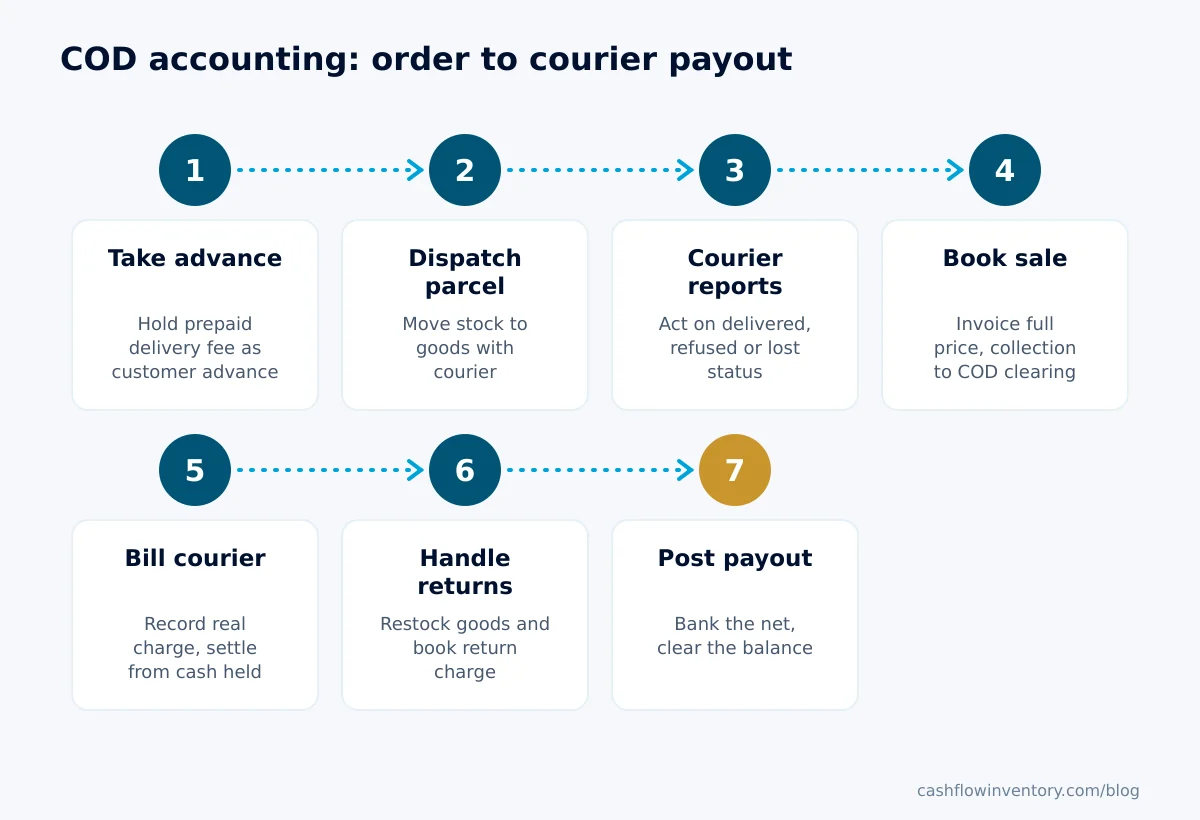
- Take any advance into Customer advances. Never into sales. Record the wallet or card reference so you can match it later.
- Move stock to Goods with courier at dispatch. Note the consignment ID against the order, because every later entry hangs on it.
- Wait for the courier’s status. “Booked” or “in transit” changes nothing in the books. Act only on delivered, partially delivered, refused or lost.
- On delivery, invoice the full price and post the collection to clearing. Apply any advance, and move the cost from Goods with courier to cost of goods sold.
- Bill the courier’s real charge per parcel and settle it against clearing. Use the courier’s figure, not the fee you charged the customer.
- On a refusal, restock and book the return charge. Inspect the goods first. Damaged items go to a write-down, not back to saleable stock.
- On payout, run the formula, then post Bank against clearing. Whatever stays in clearing should be parcels delivered but not yet paid out, and you should be able to name each one.
Month-end COD clearing checklist
- Clearing balance per courier equals the sum of delivered-but-unpaid parcels on the courier’s panel.
- No parcel in clearing is older than the courier’s normal payout cycle without a note.
- Goods with courier equals the cost of parcels still in transit or awaiting return.
- Every refused parcel is back in inventory, or written down with a reason.
- Courier payable is zero, or matches unpaid courier bills.
- Customer advances list only orders not yet delivered.
- Delivery income compared with courier charges, with the gap explained.
Common COD accounting mistakes
- Booking the payout as sales. This understates revenue and buries courier cost. Revenue is always the full price.
- Treating “delivered” as cash in the bank. Until the payout lands, the money is a receivable from the courier, and couriers do sometimes short-pay or delay payouts.
- One clearing account for every courier. You cannot reconcile a mixed balance. Use one per courier.
- Deleting refused orders. The stock still left your shelf and the return charge is still real. Keep the record and post the restock.
- Using your delivery fee as the courier’s charge. You then never see whether delivery makes or loses money.
- Recording the advance as income on the day it arrives. If the parcel is refused, you have revenue for a sale that never happened.
- Entering the same payout twice, once from the courier panel and again from the bank statement. Match the bank line to the posted payout instead.
Edge cases: partial collection, lost parcels, rounding and tax
The customer keeps part of the order
If the customer accepts one item of two and the rider collects less, invoice what was accepted, post the smaller collection to clearing, and restock the rest. If you had already invoiced the full order, issue a return for the items coming back. Our guide to sales returns and credit notes shows those entries.
You invoice at dispatch instead of delivery
The sale and receivable post at dispatch, and clearing is debited when the courier collects. A refused parcel then needs a sales return that reverses revenue and cost of goods sold, plus the return charge. The method is valid, but your sales figure swings with every refusal.
The courier loses or damages a parcel
Move the cost out of Goods with courier into a Courier claims receivable account. When the courier compensates you, credit that account, and treat any shortfall as a loss. Do not book a sale, because the customer never received the goods.
The advance on a refused parcel
Decide your policy in advance. If you refund the advance, reverse it: Dr Customer advances / Cr Wallet. If your terms say it is non-refundable, move it to income with a clear note.
Rounding
Some couriers book whole currency units, so an invoice of 1,234.50 may be collected as 1,235. Post the small difference to a rounding account rather than leaving cents in clearing for ever.
Tax on sales and on courier charges
Output VAT or sales tax normally follows the invoice. The courier’s own charges may carry tax you can reclaim if you are registered. Check the rules with your authority, for example HMRC in the UK or the National Board of Revenue in Bangladesh.
Practitioner tip: Age your clearing balance the way you age customer debts. A delivered parcel that has not appeared on two consecutive payout statements is a question for the courier now, not at year end.
How to do this in Cash Flow Inventory
Cash Flow Inventory’s cash on delivery settlement follows each parcel until the courier reports it. It works with couriers that collect the money, such as Steadfast, Pathao and RedX.
When a parcel is delivered with exactly the amount booked, the app does three things by itself: it approves the invoice, records the receipt from the cash collected, and puts the courier’s real delivery charge on its bill. Anything different goes to a person in the approvals centre. The collected cash is owed to you by the courier, in Courier / COD Clearing, until the payout.
Set-up: connect the courier and paste its webhook address and secret into the courier’s merchant panel. For courier-specific set-up, see Steadfast with WooCommerce or Pathao courier integration. Then, in Settings › Sales › Approvals › Cash-on-delivery parcels, make four choices:
- Whether to Hold the invoice until the courier reports the parcel, or approve it at issue.
- Delivered with the right amount: approve, record the payment and settle by itself, or Review every delivered parcel.
- Whether to Close the invoice once the cash settles it in full.
- Whether to Record the courier’s delivery charge as a bill, settled from the cash collected, or record courier charges only at the payout.
Daily and payout routine:
- Book the COD parcel. Its invoice shows in Sales › Invoices › Awaiting delivery.
- Let the courier’s report arrive. Matching parcels settle by themselves.
- Open Approvals › Delivered parcels (COD) for parcels in review. For each one, choose to approve as invoiced, accept what was collected, mark it returned, or keep it in review, with a reason.
- Open Integrations › the courier’s page › Reconcile parcels. You see every parcel: due, booked, collected, the courier’s status, your price against the courier’s charge, and where it stands.
- When the courier pays out, open Accounting › Courier remittances and paste the payout statement.
- Check the amount that should reach the bank, then choose Post a settlement.
An advance, such as a delivery charge paid by mobile wallet, is held as a customer advance and applied when the invoice is made. The courier collects only what is left, and revenue stays at the full price. For Steadfast, a rider’s “delivered” is checked against Steadfast’s own status before any money moves. If you run ads, the ad attribution guide explains how to report a COD sale only once it is paid.
Frequently asked questions
What is the journal entry when the courier collects cash on delivery?
Debit Courier/COD Clearing and credit Accounts receivable for the amount the rider collected. The invoice itself has already debited receivables and credited sales. Cash in the bank comes only later, when the payout moves the balance from clearing to the bank.
Is the COD clearing account an asset or a liability?
It is an asset, because the courier owes you the cash it collected. If it ever shows a credit balance, you have probably posted a payout twice or missed a delivery entry. Investigate before closing the month.
How do I record the courier’s delivery charge?
Book it as an expense, Courier charges, against Courier payable. Because the courier deducts it from the cash it holds, settle the payable against clearing. Keep it separate from any delivery fee you charged the customer, so you can see whether delivery covers its cost.
How do I account for a returned COD parcel?
If you book sales on delivery, there is no revenue to reverse. Put the goods back into inventory at cost and record any return charge. If you invoiced at dispatch, issue a sales return or credit note so that revenue, cost of goods sold and stock all reverse.
Should I record COD revenue at dispatch or at delivery?
Delivery is usually the better fit, because the customer can refuse the parcel at the door. Recording at delivery keeps refused parcels out of revenue. If your process invoices at dispatch, that still works, but you will post a return for every refusal.
Why doesn’t the courier payout match my sales?
The payout is net of the courier’s delivery, return and other charges. It covers only parcels delivered and processed in that statement. Use the payout formula on this page, and the difference will be specific parcels or deductions you can name.
Cash on delivery stays manageable when every parcel moves through the same entries: advance, dispatch, delivery, charge, return, payout. If you want those entries made for you from the courier’s own reports, with only the exceptions left for review, start a free trial of Cash Flow Inventory and connect your courier.