Markdown or Hold? The Maths for Slow-Moving Stock
A markdown only pays when the cash it brings in beats what holding will really earn after carrying costs. Here is the break-even discount formula, a worked example and copy-ready decision rules.
On this page
- Key takeaways
- Why “should I discount slow moving inventory” is a maths question
- The break-even discount formula
- Worked example: markdown or hold, with real numbers
- Steps to decide markdown or hold
- Copy-ready decision rules
- Common mistakes with discounting slow-moving stock
- Anchoring on the original margin
- Assuming deeper is always better
- Treating holding as free
- Optimistic hold forecasts
- Discounting the whole range
- Markdowns that never end
- Edge cases that change the answer
- Online sales and cash on delivery
- Seasonal, dated or perishable stock
- Supplier returns, bundles and brand rules
- Stock worth less than it cost
- When cash is the constraint
- How to do this in Cash Flow Inventory
- Frequently asked questions
- Should I discount slow-moving inventory or wait for demand to pick up?
- How much should I discount slow-moving stock?
- Is it ever right to sell stock below cost?
- How long should a clearance sale run?
- What monthly carrying cost rate should I use?
- Do markdowns change VAT or sales tax?
Discount slow-moving inventory when the money a markdown brings in, minus a shorter carrying cost, is more than holding will realistically earn at full price after carrying costs and any leftover clearance. The way to decide is to work out your break-even discount, which is the deepest markdown that still beats holding, and then choose the smallest discount that clears the stock in the time you have.
Most advice stops at “run a sale”. This page gives you the maths behind the decision. You get the formula with each part explained and a worked example in which every figure adds up. You also get a checklist of decision rules you can apply to your own slow lines today.
You will also see the edge cases that change the answer, such as fees, cash-on-delivery refusals, seasonal stock and accounting write-downs. The last section shows how to run and track a clearance in Cash Flow Inventory.
Key takeaways
- What you paid for the stock is already spent. Compare the future cash each option brings in, not the original margin.
- Holding is not free. Every month an item sits, it costs you capital, space and the risk that it ages, and those costs belong in the comparison.
- The break-even discount tells you how deep you can go before a markdown loses to holding. Going deeper than that destroys value even if the stock clears.
- Choose the smallest discount that clears the stock in time. In the example below, 25% off beats both 15% off and 40% off.
- Cash collected sooner has extra value if you can put it into stock that sells. Add that value when you are short of cash for fast movers.
Why “should I discount slow moving inventory” is a maths question
The instinct is to protect the margin you planned when you bought the stock. That margin is gone once the item stops selling. The decision in front of you is between two futures: hold the stock and sell it slowly at full price, or mark it down and sell it faster for less.
Three things decide which future is worth more:
- Carrying cost. This is the monthly cost of keeping the stock: capital tied up, storage, insurance, damage and obsolescence. Our guide to inventory carrying cost breaks it down.
- Expected sell-through. This is how many units you will actually sell at each price, based on your own history rather than hope. See how to measure sell-through rate.
- Cash now versus later. Money that comes in during month 2 can be reused. Money that arrives in month 6 cannot be used until then.
The break-even discount formula
Value each option as the cash it brings in, minus the carrying cost while you wait. Use prices net of per-unit selling costs such as card or marketplace fees and any delivery you pay for.
Carrying cost = unit-months on hand × unit cost × monthly carrying rate
Unit-months is the stock on hand at the start of each month, added up across the period. For example, 120 units for one month followed by 90 units for one month is 210 unit-months.
Hold value = units sold at full price × full price + leftover units × salvage price − carrying cost while holding
Markdown value = units sold at markdown × markdown price + leftover units × salvage price − carrying cost during markdown
The salvage price is what you would get for whatever is left at the end, from a jobber, an outlet, a bundle or a supplier return. To find the break-even, set the markdown value equal to the hold value and solve for the price:
Break-even price = (hold value + markdown carrying cost − markdown salvage) ÷ units sold at markdown
Break-even discount = 1 − break-even price ÷ full price
If your planned discount is shallower than the break-even discount and the stock still sells at the speed you assumed, the markdown wins. If it is deeper, holding wins.
Worked example: markdown or hold, with real numbers
Example: a shop selling leather office bags (hypothetical). The shop has 120 bags on hand, each costing $40 and priced at $80. Over the last quarter they sold 10 a month. Carrying cost is set at 2% of cost per month, which is $0.80 per bag per month. Anything unsold at the end of the window goes to a jobber at $30 a bag. The owner wants the stock gone within six months and compares four options.
| Line | Hold at $80 | 15% off ($68) | 25% off ($60) | 40% off ($48) |
|---|---|---|---|---|
| Expected sales per month | 10 | 15 | 30 | 60 |
| Months selling | 6 | 6 | 4 | 2 |
| Units sold at that price | 60 | 90 | 120 | 120 |
| Units left for jobber at $30 | 60 | 30 | 0 | 0 |
| Sales revenue | $4,800 | $6,120 | $7,200 | $5,760 |
| Jobber revenue | $1,800 | $900 | $0 | $0 |
| Unit-months on hand | 570 | 495 | 300 | 180 |
| Carrying cost at $0.80 | $456 | $396 | $240 | $144 |
| Net value | $6,144 | $6,624 | $6,960 | $5,616 |
| Profit over stock cost of $4,800 | $1,344 | $1,824 | $2,160 | $816 |
| Cash in by end of month 3 | $2,400 | $3,060 | $5,400 | $5,760 |
Here is how the unit-months are built. For the hold option, opening stock runs 120, 110, 100, 90, 80 and 70, which adds up to 570. At 15% off it runs 120, 105, 90, 75, 60 and 45, which is 495. At 25% off it runs 120, 90, 60 and 30, which is 300. At 40% off it runs 120 and 60, which is 180.
Reading it. 25% off wins with $6,960, which is $816 more than holding. 15% off also beats holding, but it leaves 30 bags for the jobber. 40% off clears the fastest yet loses $528 against holding, because the discount has gone past break-even.
The break-even. At the 25% option’s selling speed, the break-even price is ($6,144 + $240 − $0) ÷ 120 = $53.20, so the break-even discount is 1 − 53.20 ÷ 80 = 33.5%. At the 40% option’s speed, it is ($6,144 + $144) ÷ 120 = $52.40, a break-even discount of 34.5%. A 40% markdown goes past both, which is why it loses.
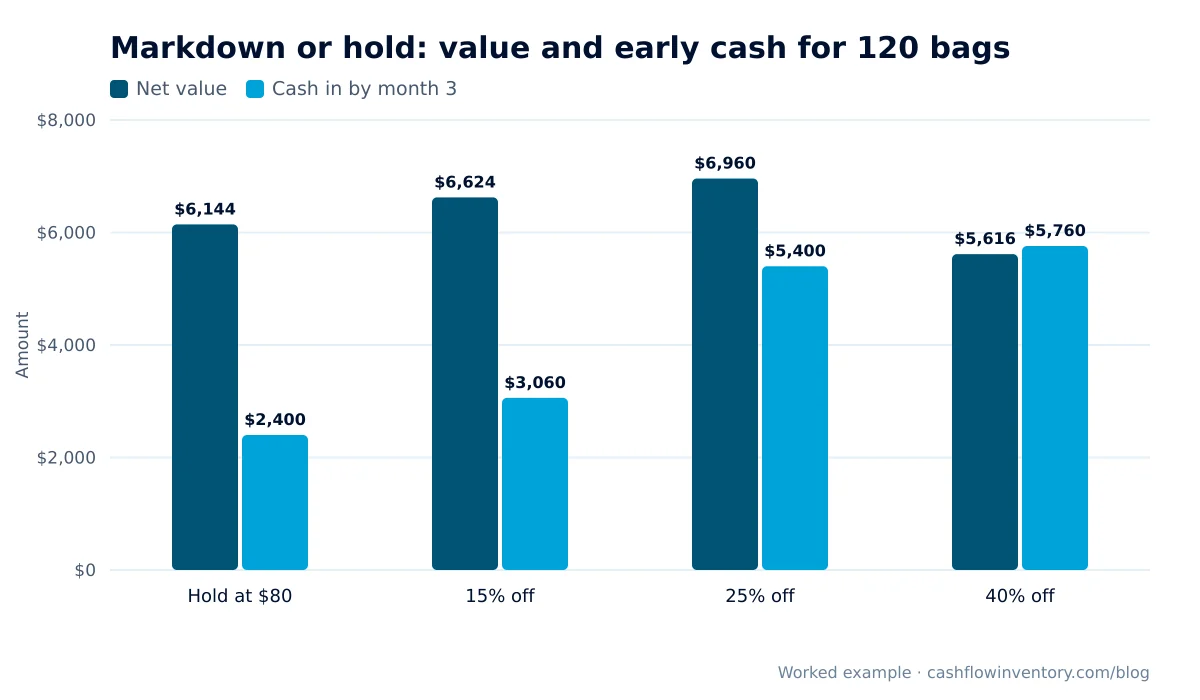
The last row of the table matters as much as the net value. By month 3, the 25% markdown has brought in $3,000 more than holding ($5,400 against $2,400). If that $3,000 can be spent on bags or wallets that sell every week, the real advantage of marking down is larger than $816. Our cash conversion cycle worked example shows how to put a value on cash freed earlier.
Steps to decide markdown or hold
- Shortlist the candidates. Pull items with long days on hand and low sell-through. An inventory aging review is the quickest way to find them.
- Count what is really there. Check the physical stock before you price a clearance. If the system says 120 and the shelf holds 85, the whole calculation is wrong.
- Set your monthly carrying rate. Use your own cost of money plus storage, insurance and shrinkage. Divide an annual rate by 12.
- Estimate sell-through if you hold. Use the last 8 to 12 weeks of sales for that item, not the season you bought it for.
- Decide the salvage route and its price. Get a real offer from a jobber, outlet or supplier, or an honest figure for bundling.
- Estimate sell-through at two or three discount levels. Use past promotions on similar items if you have them. If you do not, run the shallowest level for two weeks and measure.
- Calculate the value of each option and the break-even discount. Discard any option deeper than break-even.
- Pick the smallest discount that clears in your window, and give it a fixed end date.
- Review at a checkpoint. If sell-through falls short after two to four weeks, step down to the next level. Do not go past break-even.
Copy-ready decision rules
- Use net prices: deduct card, marketplace and delivery costs per unit before comparing.
- Ignore what you paid. It is the same in every option and does not change the ranking.
- Never go past the break-even discount for the selling speed you expect.
- If two options are within 5% of each other on value, take the one that brings in cash sooner.
- If the item will lose value at a known date (season end, expiry, model change), use that date as the end of your window.
- One markdown step at a time, with a checkpoint date written down before you start.
- Stop reordering the item the day you decide to clear it.
Common mistakes with discounting slow-moving stock
Anchoring on the original margin
“I can’t sell below $60 because I planned a 50% margin” is not part of the maths. The comparison is between future cash flows. In the example, even the jobber price of $30, which is below cost, plays a role in the best answer for holding.
Assuming deeper is always better
A bigger discount clears faster, but the price you give up on every unit can outweigh the carrying cost you save. The 40% option shows this. It is the fastest and the worst.
Treating holding as free
Leave out carrying cost and holding will look better than it really is. In the example, holding costs $456, almost double the $240 of the 25% markdown.
Optimistic hold forecasts
Slow movers rarely speed up by themselves. If you forecast the hold option from the launch months instead of recent weeks, you will hold too long.
Discounting the whole range
Put the markdown on the slow lines only. A store-wide percentage gives margin away on items that would have sold at full price anyway.
Markdowns that never end
A clearance with no end date teaches customers to wait. It also makes it impossible to measure whether it worked.
Edge cases that change the answer
Online sales and cash on delivery
Every unit sold online carries fees and often delivery costs, so the net price is lower than the tag. With cash on delivery, some discounted parcels will be refused and come back. Lower your expected sell-through or add the cost of the return trip to each order.
Seasonal, dated or perishable stock
Here the salvage value falls sharply after a date. Shorten the window to that date and value anything left at the post-season price, which may be zero. The case for an early, moderate markdown gets much stronger.
Supplier returns, bundles and brand rules
A supplier credit or a bundle with a fast seller can beat any markdown, so put it into the formula as your salvage price. Some brands set minimum advertised prices, so check before you advertise a discount.
Stock worth less than it cost
If the expected selling price is below cost, accounting standards generally require a write-down. IAS 2 Inventories measures stock at the lower of cost and net realisable value. For US businesses, IRS Publication 538 covers inventory valuation methods. Ask your accountant how this applies to you. The write-down records a loss you have already suffered. It is not a reason to keep holding.
When cash is the constraint
If you cannot buy fast movers because cash is stuck in slow stock, give the early cash extra weight. Plan the reinvestment with an open-to-buy plan so the freed money goes into lines that turn. For lines you should simply stop buying, see our guide to reducing excess inventory.
Practitioner tip: Run the calculation before you reorder, not only when stock is already stale. If a line’s break-even discount is already small at the hold speed, buy less of it next time. Our guide to managing slow-moving inventory covers the prevention side.
How to do this in Cash Flow Inventory
The calculation is yours to make. Cash Flow Inventory runs the markdown you choose and gives you the reports to check whether it is working.
- Find the slow lines. Open Reports and type what you need in the search, for example “sales by product last quarter”. The best matching report opens with its filters already set. Use Compare against the previous period to see which items are slowing down, and use Excel to export the figures into your markdown sheet.
- Create the markdown. Open Marketing › Promotions and choose New promotion. Under What it gives, pick Percent off and enter your chosen level, such as 25. Leave the code empty so the discount applies by itself.
- Limit it to the slow stock. Under On what, choose Each matching line and Chosen products, then select only the items you are clearing.
- Fix the window. Under When and how often, set the start and end dates to match your clearance window. If you only want to clear a set quantity, add a usage limit.
- Control stacking. Set Priority, and under Combines with other decide whether this discount can stack with other offers. Stacking can push you past break-even without you noticing.
- Go live. Set the Status to Live and save. The promotion applies on sales orders, at the till and on connected online stores. If it has a code, the code is pushed to a connected WooCommerce or BigCommerce store on a best-effort basis.
- Check at your checkpoint. Rerun your sales report and compare it with the period before the markdown. If you want the figure in front of you every day, use Pin as KPI. Use Schedule to have it e-mailed weekly. If sell-through is short, pause the promotion and create the next step down.
You do not need to post the discount separately. A promotion posts nothing by itself; the discount reduces the order or invoice total, and that document posts as usual. Full instructions are in the promotions and discounts guide and the reports guide.
Frequently asked questions
Should I discount slow-moving inventory or wait for demand to pick up?
Wait only if your recent sales data, not hope, shows that holding will bring in more cash after carrying costs. Calculate the hold value from the last 8 to 12 weeks of sales and compare it with a markdown. If the markdown wins at a discount below break-even, act now, because every month of waiting adds carrying cost.
How much should I discount slow-moving stock?
Choose the smallest discount that clears the stock within your window, and never go past the break-even discount. In the worked example, 25% beats both 15% and 40%. Your numbers will differ, so run the formula for two or three levels.
Is it ever right to sell stock below cost?
Yes. What you paid is already spent, so the only question is which option brings in more future cash. If a below-cost price clears the stock and beats holding after carrying costs, it is the better choice. Your accountant may also need to record a write-down to net realisable value.
How long should a clearance sale run?
Run it for as long as your calculation assumed, usually a few weeks to a few months, and set a fixed end date. Put a checkpoint halfway through. If sales fall short, step the discount down once rather than leaving the sale open-ended.
What monthly carrying cost rate should I use?
Use your own figures: your cost of borrowing or the return you could get on the cash, plus storage, insurance, damage and shrinkage. Convert the annual total to a monthly rate by dividing by 12. If you are unsure, test a higher and a lower rate and see whether the decision changes.
Do markdowns change VAT or sales tax?
In most systems, tax is charged on the price the customer actually pays, so a discount lowers the tax collected along with the sale. Check the rules for your country with your tax adviser, especially for codes and bundles.
A markdown is a pricing decision with a clear answer once you put carrying cost, sell-through and cash timing side by side. If you want to run clearance promotions and track the results from the same system that holds your stock and your books, start a free trial of Cash Flow Inventory.