Sales Returns and Credit Notes: Accounting Entries and the Stock Effect
The sales return journal entry has two halves: reverse the sale and reverse the cost. This guide works through refunds, kept credit, restocked and scrapped goods, and price allowances with real numbers.
On this page
- Key takeaways
- The sales return journal entry, in its two halves
- Half one: the revenue side (the credit note)
- Half two: the stock side
- Then, separately: the refund
- Refund, credit note, restock or scrap: which entries apply
- Decision rules for a sales return
- Worked example: a shop selling kitchen blenders
- Common mistakes with sales returns and credit notes
- Edge cases generic answers skip
- Returns across a period end
- Delivery charges
- Refunds onto a gift card
- Lots, serials and expiry
- Partial returns and price allowances on the same invoice
- Returns desk checklist (copy and use)
- How to do this in Cash Flow Inventory
- Returning goods against an invoice
- What happens to the credit
- Scrapping a returned item
- Price allowances with no goods back
- Fixing mistakes
- Online store refunds
- Frequently asked questions
- What is the journal entry for a sales return?
- Is a credit note the same as a refund?
- Do I reverse cost of goods sold on a sales return?
- What is the difference between sales returns and sales allowances?
- Where does sales returns go on the income statement?
- Should a returned item go back into stock if it is opened?
A sales return journal entry reverses the sale: debit Sales Returns (a contra-revenue account) and any sales tax, and credit Accounts Receivable or cash. If the goods come back into stock, you make a second entry: debit Inventory and credit Cost of Goods Sold, at the cost the goods originally left at, not their selling price.
That is the short answer. The rest depends on what actually happened. Did you refund the money or keep it as credit? Did the goods go back on the shelf or in the bin? Was there a return at all, or just a goodwill discount?
This page works through each of those cases with one hypothetical shop and numbers that add up. You get the entries for every case, decision rules for restock versus scrap, a returns checklist you can copy, the edge cases generic answers skip, and the exact steps in Cash Flow Inventory.
Key takeaways
- Every sales return has two halves. The revenue half (Sales Returns and tax against Accounts Receivable) and the stock half (Inventory against Cost of Goods Sold, at cost).
- A credit note and a refund are separate steps. The credit note reduces what the customer owes, and the refund pays out any credit left over.
- Scrapped goods still come back into stock first, then get written off with a stock adjustment. That keeps the loss visible as an expense rather than buried in cost of sales.
- A price allowance with no goods back reduces revenue and tax only. Stock does not move.
- Post returns to a Sales Returns account, not straight against Sales. You lose the return rate otherwise.
The sales return journal entry, in its two halves
When you sold the goods, you made two entries. One recorded revenue and the amount owed, and the other moved the goods out of stock into cost of sales. If you need a refresher on that pair, see our guide to inventory journal entries. A return simply reverses both, in whole or in part.
Half one: the revenue side (the credit note)
The credit note is the document that tells the customer, and your books, that they owe less. The entry is:
- Dr Sales Returns (net amount of the goods returned)
- Dr Sales Tax / VAT Payable (the tax that was charged on them)
- Cr Accounts Receivable (the gross amount)
Sales Returns is a contra-revenue account. It sits under Sales on your profit and loss and reduces it, so you can still see gross sales and returns separately.
Net sales = Gross sales − Sales returns − Sales allowances
Half two: the stock side
If the goods physically come back, they are inventory again:
- Dr Inventory
- Cr Cost of Goods Sold
Cost to reverse = units returned × unit cost at which they left stock
Use the cost the goods left at, under whatever method you use. Under weighted average, that is the average on the day of sale, not today’s average. Our FIFO vs weighted average worked example shows why those two numbers can differ.
Then, separately: the refund
If the customer had already paid, the credit note leaves them with a credit balance. Paying it back is its own entry: Dr Accounts Receivable / Cr Bank or Cash. If the customer keeps the credit for their next purchase, there is no refund entry. The credit simply sits on their account until it is applied.
Refund, credit note, restock or scrap: which entries apply
Four questions decide which entries you post. Answer them in order for every return.
Decision rules for a sales return
- Did goods come back? If yes, it is a return: credit note plus the stock entry. If no, it is a credit note with no goods back (a price allowance): revenue and tax only.
- Can the goods be sold again as they are? If they are sealed, undamaged, in date and complete, restock them. The stock entry stands.
- If not, can they be sent back to the supplier? Restock them first, then raise a purchase return. The entries are in our guide to purchase returns and supplier credit notes.
- If neither, scrap them. Bring them back into stock, then write them off with a stock adjustment: Dr Inventory Write-off (an expense) / Cr Inventory.
- Has the customer paid? If not, the credit note just reduces what they owe. If they have, decide: refund (cash, bank or gift card) or keep as credit.
Why not skip the restock step for scrapped goods? Because the original sale moved their cost into Cost of Goods Sold. If you never reverse it, the loss hides inside cost of sales and your gross margin looks worse for reasons nobody can trace. Restock-then-write-off puts the loss on its own line, where you can manage it.
Worked example: a shop selling kitchen blenders
Example: a shop selling kitchen appliances (hypothetical). The shop sells 10 blenders to a café on invoice INV-1042 at 60 each before tax, with 10% sales tax. Each blender cost 35. The café pays the full 660 on the day.
Afterwards, three things happen:
- Event A: 2 blenders come back unopened. They are restocked and the café is refunded by bank transfer.
- Event B: 1 blender comes back cracked in the café’s kitchen. It cannot be resold or returned to the supplier, so it is scrapped. The café keeps the credit for its next order.
- Event C: The café complains about a late delivery. The shop agrees a goodwill allowance of 33 including tax, refunded by bank, with no goods back.
| Step | Debit | Credit | Amount | Stock effect |
|---|---|---|---|---|
| Sale approved | Accounts Receivable 660 | Sales 600; Tax Payable 60 | 660 | None yet |
| Goods leave stock | Cost of Goods Sold | Inventory | 350 (10 × 35) | −10 units |
| Café pays | Bank | Accounts Receivable | 660 | None |
| A: return saved (restock) | Inventory | Cost of Goods Sold | 70 (2 × 35) | +2 sellable |
| A: credit note | Sales Returns 120; Tax Payable 12 | Accounts Receivable | 132 | None |
| A: refund | Accounts Receivable | Bank | 132 | None |
| B: return saved | Inventory | Cost of Goods Sold | 35 | +1 (damaged) |
| B: credit note (kept as credit) | Sales Returns 60; Tax Payable 6 | Accounts Receivable | 66 | None |
| B: write-off | Inventory Write-off | Inventory | 35 | −1 unit |
| C: allowance, no goods back | Sales Returns & Allowances 30; Tax Payable 3 | Accounts Receivable | 33 | None |
| C: refund | Accounts Receivable | Bank | 33 | None |
Here is where it all lands:
| Account | Result | Check |
|---|---|---|
| Net sales | 600 − 120 − 60 − 30 = 390 | 7 blenders kept × 60 = 420, less 30 allowance |
| Tax payable | 60 − 12 − 6 − 3 = 39 | 10% of 390 |
| Cost of Goods Sold | 350 − 70 − 35 = 245 | 7 blenders kept × 35 |
| Gross profit | 390 − 245 = 145 | Margin on what the café kept |
| Inventory write-off | 35 | 1 scrapped blender at cost |
| Inventory (net movement) | −350 + 70 + 35 − 35 = −280 | 8 units gone × 35 |
| Bank | 660 − 132 − 33 = 495 | Cash actually kept |
| Accounts Receivable | Credit balance of 66 | Café’s credit for its next order |
A final cross-check: the café is keeping 7 blenders at 66 each, which is 462, less the 33 allowance, giving 429. The shop holds 495 in cash and owes 66 in credit, and 495 − 66 = 429. The books agree with reality.
Notice what the scrap did. Gross profit stays clean at 145 on 7 units, and the 35 loss shows up on its own line. Had the shop skipped the restock entry for the cracked blender, cost of sales would read 280 and gross profit 110, with no clue why. You can test the margin effect with the gross margin calculator.
Common mistakes with sales returns and credit notes
- Debiting Sales directly. The totals still balance, but you can no longer see your return rate. Use Sales Returns, and Sales Returns & Allowances if you track allowances separately.
- Forgetting the stock half. The credit note goes out, but the goods sit in the back room unrecorded. Inventory is understated, cost of sales is overstated, and your next stock count throws up a mysterious gain.
- Reversing cost at selling price. Inventory goes back in at 60 instead of 35, which inflates both stock and profit.
- Refunding without a credit note. A bank payment to a customer with nothing behind it leaves Accounts Receivable wrong and your sales tax overstated. Raise the credit note first, then refund against it.
- Leaving tax out of the credit note. If tax was charged on the sale, it comes off on the return. Tax authorities expect a credit note that references the original invoice; for UK VAT, for example, see HMRC’s VAT guide (Notice 700).
- Recording an online store refund twice. Once from the store sync and once by hand. Decide which channels reach the books automatically, and only key in the rest. Our guide on preventing duplicate entries covers the habits that help.
- Issuing a credit note to fix a wrong invoice. If the invoice should never have existed (wrong customer, duplicate), void it. Credit notes are for real returns and real allowances.
Edge cases generic answers skip
Returns across a period end
If you sold in March and the goods come back in April, the April credit note reduces April’s sales. March stays closed. For a business with a high, predictable return rate, the accounting standards (IFRS 15, and ASC 606 from the FASB in the US) expect you to estimate expected returns at the period end with a refund liability. Ask your accountant whether that applies to you. Most small shops record returns as they happen.
Delivery charges
Returning goods does not automatically mean refunding the shipping you charged. If you choose to refund it as goodwill, treat it as an allowance: a credit note with no goods back.
Refunds onto a gift card
Refunding to a gift card is still a refund in the books, but the money does not leave. Instead of crediting Bank, you credit a gift card liability, which stays on your balance sheet until the card is spent. See how gift cards and store credit keep that liability right.
Lots, serials and expiry
For batch-tracked or serialised goods, the item coming back must be the one that left. Accepting a different serial number puts the wrong unit, and possibly the wrong cost, back into stock. For expiry-dated goods such as medicines or food, restock only if the item is still within its sellable life. Otherwise, write it off.
Partial returns and price allowances on the same invoice
The total credit on an invoice can never exceed the invoice itself. In the example, after crediting 132 and 66, only 462 was left to credit. The 33 allowance fitted, but a 500 allowance would not.
Returns desk checklist (copy and use)
- Find the original invoice. No invoice, no return; ask for the invoice number or look up the customer.
- Count what came back, line by line, against what was sold.
- Record the reason (faulty, wrong item, changed mind, damaged in transit) and the condition (sellable, damaged, expired).
- For tracked items, check the lot or serial number matches what left on that invoice.
- Decide restock, return to supplier or scrap, using the decision rules above.
- Raise the credit note with tax, referencing the invoice.
- Ask the customer: refund (cash, bank, gift card) or keep as credit. Record the answer.
- For scrapped goods, raise a stock adjustment the same day with a photo attached.
- Put sellable goods back in their proper location, not a “returns” pile that never gets counted.
- Each week, review return reasons by product. A pattern points at a supplier, a listing or a packing problem.
How to do this in Cash Flow Inventory
In Cash Flow Inventory, returns live under Sales › Returns, which has three tabs: Returns, Credit notes and Refunds. The goods must have been sold on an approved invoice. The person entering the return needs the right to add sales returns, and refunds need the customer refunds right. The full reference is in the sales returns, credit notes and refunds guide.
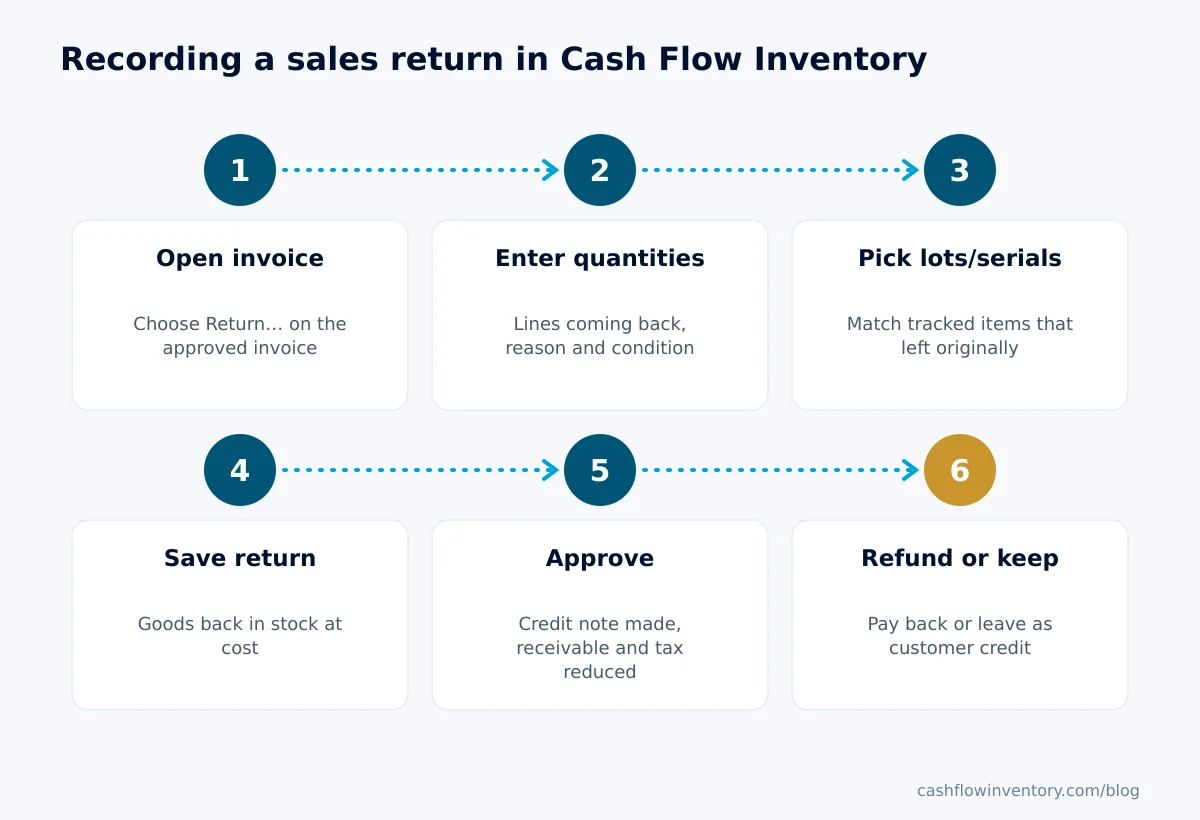
Returning goods against an invoice
- Open Sales › Invoices and choose Return… on the invoice. Alternatively, choose New return on Sales › Returns and pick the invoice.
- Enter the quantity of each line coming back, with the reason and condition.
- For tracked items, choose the lots or serial numbers coming back. The app offers the ones that left on that invoice’s pick.
- Save. The goods are back in stock and the return waits for approval. This posts Dr Inventory / Cr Cost of Goods Sold, at the cost the goods left at.
- Approve the return. The credit note is made and posts Dr Sales Returns / Cr Accounts Receivable, with the tax.
- Refund the credit note from the Refunds tab, or leave it as the customer’s credit. A refund posts Dr Accounts Receivable / Cr the account the money left from.
For a counter return where you want the return and credit in one go, the New menu also has Quick return.
What happens to the credit
The credit first reduces what the invoice still owes. Anything beyond that becomes the customer’s credit. It can pay another invoice for the same customer, or be refunded from Undeposited Funds or a cash or bank account. Refunds can also go onto a gift card. Delivery and other cost lines are never returned.
Scrapping a returned item
After saving the return, record the damaged unit in stock adjustments. Each adjustment waits for approval, then stock and the journal move together at cost. Attach the photo, and it will appear in the documents list alongside the return.
Price allowances with no goods back
On the approved invoice, choose Credit note (no goods back)…. Enter the amount, the reason, and whether to pay back now. Revenue and tax go down in the invoice’s own proportion, and stock does not move. It posts Dr Sales Returns & Allowances / Cr Accounts Receivable, with tax carved out. It can’t be more than the invoice still carries after earlier credit notes.
Fixing mistakes
A return still waiting for approval can be corrected with Correct…: it is reversed and entered again under its number. Once approved, Uncredit undoes the approval, as long as no credit has been applied or refunded. If the invoice itself was wrong, use Void… on the invoice instead of a credit note.
Online store refunds
A refund made on a connected store is carried into the books by itself, once. The result depends on where the order had got to:
- Already invoiced: a store-refund credit note is made, and the money is paid back from the account the store’s payments came into.
- Not invoiced yet: the order’s advance is reduced.
- Fully refunded with nothing picked: the order is cancelled.
This covers WooCommerce, Shopify, BigCommerce, Wix, Squarespace and TikTok Shop, among others. Refunds on Amazon, ePages, Shopee, Lazada and Walmart are not carried in yet, so record those yourself with the steps above. If you also use QuickBooks Online or Xero, the accounting software sync sends credit notes and payments across once each, under your own numbers.
Frequently asked questions
What is the journal entry for a sales return?
Debit Sales Returns and Sales Tax Payable, and credit Accounts Receivable for the gross amount. If the goods come back into stock, also debit Inventory and credit Cost of Goods Sold at the original cost. If you then refund a customer who had already paid, debit Accounts Receivable and credit Bank or Cash.
Is a credit note the same as a refund?
No. A credit note reduces what the customer owes you. A refund is the money you pay back when the credit note leaves them with a credit balance. A customer can hold a credit note and never take a refund, by using it against their next invoice.
Do I reverse cost of goods sold on a sales return?
Yes, whenever goods physically come back, even if you later scrap them. Reverse at the cost they left stock at. Then, for scrapped goods, write them off with a stock adjustment, so the loss shows as its own expense.
What is the difference between sales returns and sales allowances?
A return means goods came back. An allowance is a price reduction where the customer keeps the goods, such as a goodwill discount for a late delivery or a minor fault. Both reduce revenue and tax, but only a return moves stock.
Where does sales returns go on the income statement?
Directly under gross sales, as a deduction, to arrive at net sales. Keeping it on its own line lets you track your return rate by month or product. Many businesses also show allowances separately.
Should a returned item go back into stock if it is opened?
Only if you can sell it again at full price as it is. If it needs repair, repackaging or a discount, decide whether to return it to the supplier, sell it as a second, or write it off. Do not let opened returns sit in sellable stock where they will be counted and picked as new.
Returns are where stock and accounts most often drift apart. Getting both halves of the entry right every time is easier when one action moves the goods and the books together. To see that in practice, start a free trial of Cash Flow Inventory and run your next return through Sales › Returns.