Inventory for Organic and Natural Food Brands: Shelf Life, Batches and Direct Sales
A practical playbook for small organic and natural food brands: size each batch to its sellable window, track every lot for recall, ship soonest-expiry first and handle COD returns safely. Includes a worked example with full numbers.
On this page
- Key takeaways
- Why food inventory management is different for small organic brands
- How to size a batch to its shelf life: the formula
- Worked example: one batch of nut butter from production to last sale
- Step 1: size the batch
- Step 2: cost the batch
- Step 3: follow every jar
- Step 4: the money
- Step-by-step: from batch plan to last sale
- COD returns of food: a decision rule you can copy
- Returned food parcel: restock or write off
- Common mistakes in food inventory management
- Edge cases generic answers skip
- Gift boxes and bundles with mixed expiry
- Raw materials with their own lots
- Partial QC failures and rework
- Co-packers and bought-in finished goods
- Wholesale buyers with stricter date rules
- Seasonal peaks
- How to do this in Cash Flow Inventory
- Switch on batches, expiry and quality control
- Make and release a batch
- Sell, write off and trace
- Settle COD parcels
- Quarterly recall drill (30 minutes)
- Frequently asked questions
- What is the difference between FIFO and FEFO for food?
- How do I calculate how much of a short-shelf-life product to make?
- Can I resell a food product returned by a COD customer?
- Do small food brands really need batch tracking?
- Should expired stock count in my cost of goods?
- Start with your next batch
Food inventory management for organic and natural brands has three parts. You size each batch to what you can sell before it expires, record a lot number and expiry on every unit you make and sell, and ship the soonest-expiring lot first. If you sell direct with cash on delivery (COD), you also treat every returned parcel as both a stock decision and a food-safety decision. A returned parcel is never an automatic restock.
Generic advice stops at “use FIFO and watch expiry dates”. This page gives you the rest. You get a formula for the largest batch you should make, and a worked example that follows one batch of nut butter from the kettle to the last jar, money included. You also get a returns decision rule, a recall drill checklist, and the exact steps to run all of it in Cash Flow Inventory.
The method suits brands making jams, nut butters, granola, ghee, honey, pickles, sauces, baked snacks or fresh juices in small runs, and selling through their own website, social media, a few shops or a marketplace.
Key takeaways
- Your real selling window is shorter than the printed shelf life. Subtract the days a batch waits for quality checks and the minimum shelf life a customer should receive.
- Cap every batch at average daily sales × sellable days, minus the stock you will still have when it is released. Then make a little less than that cap.
- Give every batch a unique lot number and expiry, and record which lot left in every parcel. Without that, a recall becomes a guess.
- Do not restock returned COD parcels automatically. Check the seal, storage conditions and remaining shelf life first.
- Count the cost of waste per batch: scrapped units, written-off returns and expired stock all sit inside your cost of goods.
Why food inventory management is different for small organic brands
Natural products usually drop the preservatives, stabilisers or processing that give mass-market food a long shelf life. A cold-pressed nut butter or a raw-honey blend might have weeks or a few months, not years. Every day a jar sits unsold is a day of value gone. In general retail, unsold stock waits; in food, it expires.
Small-batch production adds a second pressure. Each batch is a separate event, with its own ingredients, its own supplier lots and its own risk of a fault. When something goes wrong, you need to know which batch, which raw materials went into it, and which customers received it. This is a different problem from managing freshness in a restaurant kitchen, where stock is consumed on site rather than shipped to strangers.
Direct sales with COD add a third pressure. The customer pays the courier at the door, so a refused parcel comes back days later. It may have spent that time in a hot van. Your stock count, your cash and your food safety all depend on handling that return properly.
Food safety regulators such as the UK’s Food Standards Agency and the US Food and Drug Administration expect food businesses to trace products one step back to suppliers and one step forward to customers. International guidance is collected by the Codex Alimentarius. Check the rules where you sell. Batch tracking is the stock-side half of meeting them.
How to size a batch to its shelf life: the formula
Start from the printed shelf life and work back to the days you can actually sell.
Sellable days = shelf life − QC hold days − minimum days left at dispatch
- Shelf life is the number of days from the date made to the expiry or best-before date on the label.
- QC hold days are the days a batch waits after production for inspection, lab results or sign-off before you can sell it.
- Minimum days left at dispatch is your promise to customers. No order leaves with less shelf life than this. Shops and distributors often set their own minimum, usually a higher one.
Maximum batch size = average daily sales × sellable days − stock on hand when the batch is released
- Average daily sales should come from the last four to eight weeks, across all channels, in units.
- Stock on hand when released is what you expect to still hold from earlier batches on release day. Those units will sell first, because they expire first.
Treat the result as a ceiling, not a target. Demand for small brands swings with promotions, weather and holidays such as Ramadan, Eid, Diwali and Christmas. Making 80 to 90 percent of the cap leaves room for a slow fortnight. For the general trade-off between lean runs and buffers, see these food and beverage inventory strategies.
Worked example: one batch of nut butter from production to last sale
Example: a shop selling cold-pressed peanut butter online with COD. “Green Jar Pantry” is a hypothetical brand that sells 340 g jars at BDT 380 through its website and social media. Most orders are paid in cash to the courier. The brand pays delivery itself. The jars have a 90-day shelf life.
Step 1: size the batch
| Input | Value |
|---|---|
| Shelf life | 90 days |
| QC hold (weight, seal and taste check) | 2 days |
| Minimum days left at dispatch | 21 days |
| Sellable days (90 − 2 − 21) | 67 days |
| Average daily sales | 12 jars |
| Demand in the window (12 × 67) | 804 jars |
| Stock on hand at release | 84 jars |
| Maximum batch size (804 − 84) | 720 jars |
| Batch actually made (about 83% of the cap) | 600 jars |
Step 2: cost the batch
| Component | Calculation | Cost (BDT) |
|---|---|---|
| Peanuts | 210 kg × 280 | 58,800 |
| Jars and lids | 600 × 45 | 27,000 |
| Labels with lot and expiry | 600 × 6 | 3,600 |
| Labour (operations) | 16 hours × 150 | 2,400 |
| Total batch cost | 91,800 | |
| Cost per jar | 91,800 ÷ 600 | 153 |
Step 3: follow every jar
| Where the jars went | Jars |
|---|---|
| Made | 600 |
| Failed QC and scrapped (under-weight or poor seal) | 12 |
| Released for sale (600 − 12) | 588 |
| Delivered and paid by COD (270 parcels of 2 jars) | 540 |
| Returned and written off (seal doubtful or under 21 days left) | 14 |
| Sold near-date at BDT 250 to a local shop | 22 |
| Expired unsold and written off | 12 |
| Check: 540 + 14 + 22 + 12 | 588 |
Twenty parcels (40 jars) were refused. Of those 40 jars, 26 passed the returns check, were restocked and later delivered, so they are counted inside the 540. The other 14 were written off.
Step 4: the money
| Line | Calculation | BDT |
|---|---|---|
| COD sales | 540 × 380 | 205,200 |
| Near-date sales | 22 × 250 | 5,500 |
| Total revenue | 210,700 | |
| Cost of the whole batch | 600 × 153 | 91,800 |
| Courier: delivered parcels | 270 × 70 | 18,900 |
| Courier: refused parcels (delivery plus return) | 20 × 100 | 2,000 |
| Gross profit after courier | 210,700 − 91,800 − 18,900 − 2,000 | 98,000 |
| Courier payout for COD parcels | 205,200 − 20,900 | 184,300 |
| Cost of jars that earned nothing | (12 + 14 + 12) × 153 | 5,814 |
What the numbers tell you: waste cost BDT 5,814, which is 38 jars or about 6% of the batch. The 12 expired jars show that 600 was still slightly too many for a month when sales slowed. Next time the brand could make 560, or plan its near-date channel earlier. The 14 returned write-offs are a COD problem, not a production one, and that is where the next saving lies.
Step-by-step: from batch plan to last sale
This is the routine that keeps every jar traceable and every expiry visible. It works the same for a 50-unit pilot or a 2,000-unit run.
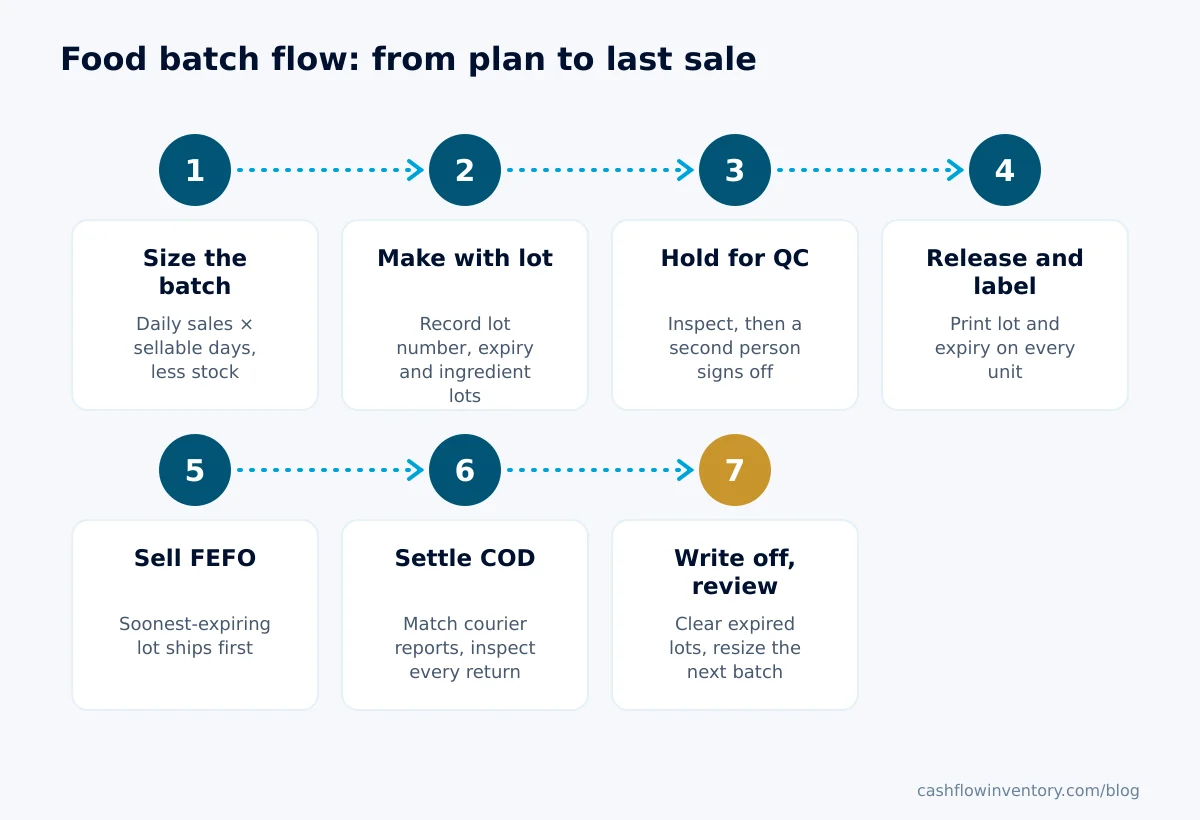
- Size the batch. Run the two formulas above with fresh sales data. Note the cap and the quantity you will actually make.
- Make it with a lot number and expiry. Give the batch a unique lot number. Set the expiry from the production date, not the packing date if those differ. Record which supplier lots of each raw material went in.
- Hold it for inspection. Keep the batch out of saleable stock until weight, seal, taste, moisture or lab checks are done. One person records the result. A different person signs off.
- Release and label. Only the passed quantity becomes saleable. Print lot and expiry on every unit and on outer cartons.
- Sell soonest-expiry first. Pick by first expiry, first out (FEFO), not by arrival. Record the lot on every order line so each parcel is traceable. The FEFO step-by-step guide for pharmacies shows the same discipline in a stricter setting.
- Settle COD and handle returns. Match courier reports to invoices. Inspect every refused parcel before deciding whether to restock it or write it off.
- Clear expired stock and review. Write off anything past expiry, compare actual waste with the plan, and adjust the next batch size.
COD returns of food: a decision rule you can copy
A refused COD parcel is the most common way good food becomes waste for direct sellers. Use one rule for everyone on the team, so the decision does not depend on who opens the box.
Returned food parcel: restock or write off
- Is the tamper seal intact and the container undamaged? If no, write it off.
- Was it a chilled or frozen item that left the cold chain? If yes, write it off.
- Was it out for more than your set limit, for example 5 days in summer heat? If yes, write it off or move it to staff use under your own food-safety policy.
- Does it still have at least your minimum days left at dispatch? If no, sell it near-date only if that is allowed and safe, otherwise write it off.
- Is the lot under any hold, complaint or recall? If yes, quarantine it.
- All clear? Restock it to the same lot, never to a newer one, and note who checked it.
Cutting refusals at the source saves more than any returns rule. Confirm high-value orders by phone, take a small advance on first orders, and block repeat refusers. The checklist for reducing fake COD orders covers these in detail.
Common mistakes in food inventory management
- Sizing batches to the machine, not the market. A kettle that holds 1,000 jars does not mean you can sell 1,000 jars inside the window. Fill the kettle only if the formula agrees.
- Using shelf life as the selling window. Without subtracting QC days and minimum days left, you plan to sell jars that you cannot ship in good conscience.
- Merging lots in the system. Topping up a nearly finished lot with a new batch under one stock line destroys traceability. Two production dates always mean two lots.
- Picking by shelf position. Newer stock gets put in front and the older lot expires at the back. Pick by system lot, not by reach.
- Counting scrap and expiry as “not real” costs. They belong in cost of goods. Ignoring them makes your margin look healthier than your bank balance.
- Booking COD cash as received on delivery. The courier holds that money until payout. Treat it as owed by the courier until the remittance lands.
- No recall drill. The first time you trace a lot should not be the day a customer falls ill.
Edge cases generic answers skip
Gift boxes and bundles with mixed expiry
A hamper with honey, granola and nut butter carries three lots and three expiries. The box expires when its shortest-lived item does. Track the components, not just the box. The guide to tracking inventory for bundles and kits explains how.
Raw materials with their own lots
Organic certification and allergen control both depend on knowing which supplier lot of almonds, oats or sesame went into which batch. Receive ingredients with their lot and expiry too. Otherwise you can trace forward to customers but not back to the farm.
Partial QC failures and rework
If 40 jars of a 600-jar batch are under-weight, you can top them up (rework) or scrap them. The rework and scrap together cannot exceed the 40 rejected. Record which you did, because reworked units may need a second check.
Co-packers and bought-in finished goods
If a co-packer makes your product, you do not run production. You still receive each delivery as a lot with its expiry and should hold it until you have checked it.
Wholesale buyers with stricter date rules
Shops often refuse stock with less than half or two-thirds of its life left. When you sell both direct and wholesale, reserve your freshest lot for the shop order. Let direct customers take the older, still-compliant lot.
Seasonal peaks
Before Ramadan or the year-end gifting season, split one large planned run into two smaller ones a few weeks apart. Each lot then starts its clock closer to when it sells.
How to do this in Cash Flow Inventory
Cash Flow Inventory covers production, lots, quality control and COD settlement in one place. These are the settings and screens to use, with the names exactly as they appear.
Switch on batches, expiry and quality control
- In Settings › Inventory, set Batch tracking to Yes. For Expired batches, choose Block — it can’t be sold or used, or Warn, then allow. For food, Block is the safer choice.
- On each product, switch on Track batches & expiry. Switch on Quality check before sale for anything that needs inspection.
- In Settings › Production, switch Quality control on, and its release gate if only released lots may be sold or used. With the gate on, an unreleased in-house lot is refused for sale with the message “has not been released by Quality Control”.
Make and release a batch
- Set up the recipe as a bill of materials, so the app can roll up the cost per unit. The bills of materials and recipes guide shows how.
- Open Production › Work orders and choose New work order. Enter the Item, How many, Made at and dates, then the Batch / lot no and Batch expires. The app works out cost per unit as (materials + operations) ÷ quantity. See the production work orders guide.
- On the work order, choose Make a batch… and tick Send it all to quality control now.
- In Production › Quality control › To inspect, choose Inspect…. Enter the Result (Pass or Fail), the passed quantity, and any reject reason, rework and scrap. Then sign with your password in Electronic signature.
- A different person opens To sign off and chooses Sign off…. Once approved, the batch is Released and can be sold. Each batch keeps a signed audit trail.
Sell, write off and trace
- Sales draw the lot that expires soonest first, and the lot’s expiry shows wherever you choose one.
- Labels can print the lot and expiry.
- Inventory › Stock counts › Write off expired stock writes off every expired lot at a location in one step.
- Production › Lot genealogy traces a lot back to what it was made from and forward to where it went. Use it for your recall drill.
The full procedure is in the batches, lots and quality control guide.
Settle COD parcels
- Connect your courier. Steadfast is proven live; Pathao and RedX are tested against each provider’s sandbox.
- In Settings › Sales › Approvals › Cash-on-delivery parcels, choose to hold the invoice until the courier reports the parcel. Also choose how parcels delivered with the right amount are handled.
- Parcels delivered with exactly the booked amount settle by themselves. Review the rest in Approvals › Delivered parcels (COD), where you can approve, accept what was collected, mark the parcel returned, or keep it in review with a reason.
- When the courier pays out, open Accounting › Courier remittances, paste the statement, check the amount and choose Post a settlement.
Until the payout, collected cash sits in Courier / COD Clearing, not in your bank. Details are in the cash on delivery settlement guide.
Quarterly recall drill (30 minutes)
- Pick one lot sold in the last 60 days.
- Trace it back: list every raw material and its supplier lot.
- Trace it forward: list every customer, order and parcel that received it.
- Count what is still on hand at every location.
- Time the exercise. If it took longer than an hour, fix the gap before you need it for real.
Frequently asked questions
What is the difference between FIFO and FEFO for food?
FIFO (first in, first out) ships the oldest received stock first. FEFO (first expiry, first out) ships the stock that expires soonest first. For food, FEFO is the right rule, because two lots received in the same week can carry very different expiry dates.
How do I calculate how much of a short-shelf-life product to make?
Work out sellable days as shelf life minus QC hold days minus the minimum days left you promise customers. Multiply that by average daily sales, then subtract the stock you will still hold on release day. Make a little less than the result to allow for slow weeks.
Can I resell a food product returned by a COD customer?
Only if it passes a defined check. The seal must be intact, a chilled item must not have left the cold chain, the time in transit must be within your limit, and enough shelf life must remain. If any of these fail, write it off. Always restock to the original lot.
Do small food brands really need batch tracking?
Yes, if you ship to customers you cannot easily reach again. Batch tracking is what lets you recall only the affected lot and contact only the customers who received it. Without it, you have to pull everything and reach everyone.
Should expired stock count in my cost of goods?
Yes. Scrapped, expired and written-off units cost you ingredients, packaging and labour, so they belong in the batch’s cost. Tracking them per batch shows whether the next run should be smaller.
Start with your next batch
You do not need to rebuild everything at once. Size your next batch with the formula, give it a lot and expiry, and run the returns rule on every refused parcel for a month. The waste figure will tell you where to go next. If you want production, lots, quality sign-off and COD settlement working together, start a free trial of Cash Flow Inventory and set up your first batch today.