Revenue Recognition for Product Sellers: When Is a Sale a Sale?
When does a product sale become revenue: at the order, the payment, the dispatch or the delivery? This guide applies the IFRS 15 / ASC 606 control test to counter sales, cash on delivery, deposits, pre-orders and bundles with service, and works through one month of sales with numbers that reconcile.
On this page
- Key takeaways
- What “control” means for a product sale: the IFRS 15 / ASC 606 test in plain words
- The signals that control has passed
- When to recognise revenue: decision rules for delivery, COD, deposits and pre-orders
- Bundles with installation or service: splitting the price
- Worked example: one month of sales at a coffee equipment shop
- How to decide when a sale is a sale, step by step
- Month-end revenue cut-off checklist
- Common revenue recognition mistakes product sellers make
- Edge cases that generic answers skip
- Partial delivery and partial COD collection
- Pre-orders on a web store
- Bill-and-hold
- Consignment stock
- Delivery charges
- Rights of return
- How to do this in Cash Flow Inventory
- Deposits and pre-orders
- Delivered orders
- Cash on delivery
- Frequently asked questions
- Is revenue recognised when the invoice is issued?
- When do you recognise revenue on a cash-on-delivery order?
- Is a customer deposit revenue?
- When should pre-order revenue be recognised?
- Is the shipping fee I charge customers part of revenue?
Under IFRS 15 and ASC 606, a product sale becomes revenue when control of the goods passes to your customer. In practice that means the moment they can use the goods and you can no longer redirect them: at the counter for a shop sale, and at delivery for most online and courier orders. Taking an order, receiving a deposit, issuing an invoice early or getting a courier payout does not, on its own, make anything a sale.
The rule fits in one line, but the hard part is applying it to real orders. This page covers how to apply the control test to cash on delivery, deposits, pre-orders and bundles that include installation or a service plan. You get a decision table you can copy, a price-split formula for bundles, one month of hypothetical sales worked through with numbers that reconcile, a month-end cut-off checklist and the exact setup in Cash Flow Inventory.
Key takeaways
- Revenue for product sales is recognised when control passes to the customer. That is usually at the counter or at delivery, not when the order or the money arrives.
- Cash received before control passes is a liability you owe the customer: a deposit, a pre-order or an advance. It is not income.
- A cash-on-delivery sale is revenue when the parcel is delivered. The cash the courier holds is a receivable from the courier until the payout reaches you.
- Bundles that mix goods with installation or a service plan are split by standalone selling prices. Each part is recognised when that part is delivered.
- Sales tax and VAT you collect are never revenue, and courier fees are a cost. They are not a deduction from the sale price.
What “control” means for a product sale: the IFRS 15 / ASC 606 test in plain words
Both the international standard (IFRS 15 Revenue from Contracts with Customers) and its US twin, ASC 606, issued by the Financial Accounting Standards Board, use the same five-step model. Here is each step in plain words:
- Is there a deal? There must be an agreed order with clear terms, and it must be likely you will be paid.
- What did you promise? List each separate thing: the goods, installation, a maintenance plan, a delivery service.
- What is the price? Exclude sales tax and VAT. Allow for discounts, rebates and expected returns.
- Split the price across the promises in proportion to what each would sell for on its own.
- Recognise each part when you hand it over (goods) or as you perform it (a service over time).
The signals that control has passed
For goods, control passes at a point in time. Look for these signals together. You rarely need every one, but the more that are true, the clearer it is:
- The customer has physical possession of the goods.
- The customer has legal title.
- You have a present right to payment.
- The risks and rewards of ownership (damage, loss, resale gain) sit with the customer.
- The customer has accepted the goods, or acceptance is a formality.
A simple test to ask yourself is this: could I still sell this item to someone else, or would I bear the loss if it broke in a van right now? If the answer is yes, it is not yet a sale.
When to recognise revenue: decision rules for delivery, COD, deposits and pre-orders
Shipping terms decide the moment for business-to-business orders. Under shipping-point terms such as the ICC’s Incoterms rules EXW or FCA, control usually passes when the goods are handed to the buyer or their carrier. Under delivered terms, it passes at the destination. For consumers, many legal systems, including UK consumer law, keep the risk with you until the goods reach the buyer, so online retail revenue normally lands at delivery.
The table below sets out the rules most product sellers need. Copy it into your accounting manual.
| Situation | Revenue is recognised | What you book before that |
|---|---|---|
| Counter or POS sale | At the till, when the customer leaves with the goods | Nothing |
| Online order, your van or your courier, consumer buyer | On delivery to the customer | Goods stay in your stock while in transit |
| B2B order, shipping-point terms (buyer’s carrier collects) | When handed to the buyer’s carrier | Nothing |
| Cash on delivery | On delivery, when the courier confirms it | Stock in transit. After delivery, a receivable from the courier until the payout |
| Refused or returned COD parcel | Never, for that parcel | Stock comes back. Any courier charge is a cost |
| Deposit on an order | When the goods are delivered | Customer advance (a contract liability) |
| Pre-order paid in full | When the goods ship or arrive, under your terms | Customer advance for the full amount |
| Goods plus installation or service plan | Goods on delivery, installation when done, the plan over its term | The unearned part of the plan stays a liability |
For the cash side of COD, including how fees and refused parcels hit your books, see how to record courier delivery charges and COD fees. If refusals are eating your margin, this checklist for reducing fake COD orders helps you stop the problem upstream.
Bundles with installation or service: splitting the price
When you sell a machine with installation and a year of maintenance for one price, you have made three promises. Each part gets a slice of the price based on what it would sell for on its own (its standalone selling price). The bundle discount is shared across all of them, unless you have clear evidence it belongs to one item.
Allocated price of an item = bundle price × (standalone price of the item ÷ sum of standalone prices of all items in the bundle)
The parts of the formula work like this:
- Bundle price is what the customer actually pays, excluding tax.
- Standalone price is your normal list price for that item sold alone. If you never sell it alone, estimate it from cost plus a normal margin or from market prices.
- Sum of standalone prices is what the bundle would cost if bought piece by piece.
If the installation is simple and anyone could do it, it is a separate promise. If the product does not work without your specialised setup, the goods and installation may be one promise, recognised when the installed product is handed over. For the commercial side of bundling, see smart product bundling strategies.
Worked example: one month of sales at a coffee equipment shop
Example: a shop selling espresso machines and coffee gear, both in-store and online with courier delivery. It is hypothetical, and all amounts exclude sales tax. The month is October and the books close on 31 October.
First, the bundle sold on 1 October: a machine, installation and 12 months of maintenance for 2,700. The maintenance runs from 1 October.
| Item in bundle | Standalone price | Calculation | Allocated price |
|---|---|---|---|
| Espresso machine | 2,400 | 2,700 × 2,400 ÷ 3,000 | 2,160 |
| Installation | 200 | 2,700 × 200 ÷ 3,000 | 180 |
| 12-month maintenance plan | 400 | 2,700 × 400 ÷ 3,000 | 360 (30 a month) |
| Total | 3,000 | 2,700 |
Now the whole month:
| Transaction | Status at 31 October | Cash received in October | Revenue for October | Owed to customers (contract liability) | Owed to you by courier |
|---|---|---|---|---|---|
| 1. Counter sale, paid by card | Customer took the goods | 1,200 | 1,200 | 0 | 0 |
| 2. COD parcel, 800 | Delivered 29 Oct, payout due 5 Nov | 0 | 800 | 0 | 800 |
| 3. COD parcel, 600 | Dispatched 30 Oct, delivered 2 Nov | 0 | 0 | 0 | 0 |
| 4. COD parcel, 450 | Refused, on its way back | 0 | 0 | 0 | 0 |
| 5. Deposit on a 4,000 grinder | 1,000 paid, delivery in November | 1,000 | 0 | 1,000 | 0 |
| 6. Pre-order: 20 kettles at 150 | Paid in full, shipping in December | 3,000 | 0 | 3,000 | 0 |
| 7. Machine bundle (above) | Delivered and installed 1 Oct, 1 month of plan used | 2,700 | 2,370 (2,160 + 180 + 30) | 330 | 0 |
| Totals | 7,900 | 4,370 | 4,330 | 800 |
The check: cash received plus amounts owed to you (7,900 + 800 = 8,700) equals revenue plus amounts you still owe customers (4,370 + 4,330 = 8,700). If your own month does not balance this way, something is in the wrong bucket.
What cash-basis thinking would have shown: October “sales” of 7,900, which is 3,530 too high. It would also have missed the 800 COD sale entirely, because that cash only arrives in November. The 600 parcel in transit stays in stock at 31 October, and the 450 refused parcel never becomes revenue.
The cost of goods sold follows the same timing. Release stock cost only for transactions 1, 2 and the machine in 7. The cost method you use changes the profit figure, as shown in FIFO vs weighted average cost.
How to decide when a sale is a sale, step by step
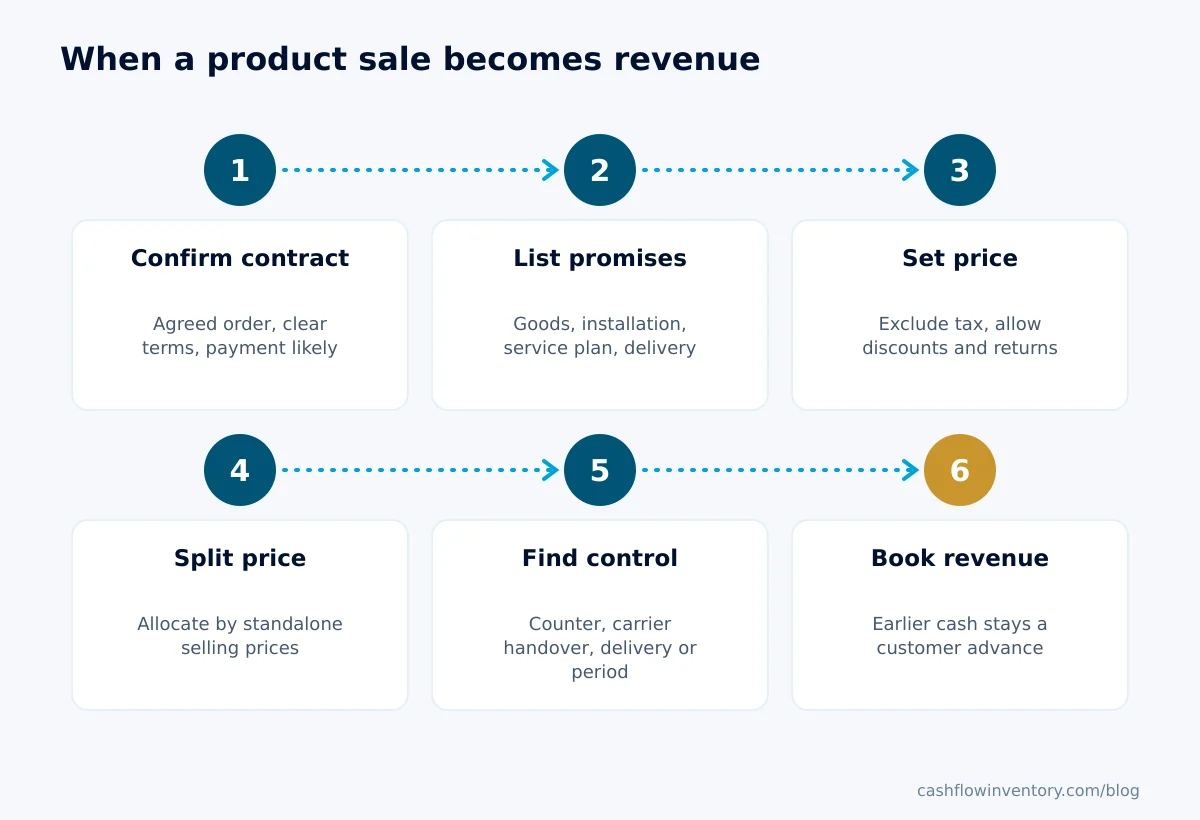
- Confirm the contract. Check there is an accepted order with a price, terms and a customer you reasonably expect to collect from. A cart that has not been confirmed is not a contract.
- List every promise. Write down the goods, any installation, training, warranty beyond the legal minimum, service plan or delivery you charge for. Ask whether each could be bought separately.
- Set the transaction price. Start from the agreed price. Take out tax, take off discounts and allow for returns you expect, based on your own return history.
- Split the price using the allocation formula above if there is more than one promise.
- Find the control moment for each promise. Use your shipping terms and the control signals: counter, carrier handover, delivery, installation date or the service period.
- Book revenue at that moment, and only then. Anything received earlier sits as a customer advance. Anything delivered but unpaid sits as a receivable, from the customer or from the courier.
Month-end revenue cut-off checklist
- Every parcel dispatched in the last week has a delivery status. Undelivered parcels stay in stock, not in sales.
- COD parcels delivered but not yet paid out are a receivable from the courier, matched to the courier’s statement.
- Refused and returned parcels have no revenue, and their stock is back on hand or written down if damaged.
- Every deposit and pre-order payment is in a customer advance account, not in sales.
- Bundles have been split, and unused months of service plans are still a liability.
- Sales tax and VAT are in the tax payable account, not in revenue.
- Courier fees and payment fees are expenses, and the sale is booked at the full price.
- Credit notes for goods returned in the month are posted against the original sale.
Common revenue recognition mistakes product sellers make
- Booking revenue when the order is placed. Order dashboards look great, but if the parcel has not arrived, it is not a sale.
- Booking COD sales when the courier pays out. This pushes revenue into the wrong month and hides how much cash the courier is holding for you.
- Booking COD sales at dispatch. This overstates sales by every parcel later refused, and in COD-heavy markets those refusals add up.
- Netting the courier fee off the sale. If you sold for 800 and the courier kept a fee, revenue is still 800 and the fee is a delivery expense.
- Treating deposits as income. If the order is cancelled, you may have to refund the money, which is exactly why it is a liability.
- Recognising a whole service plan up front. Twelve months of maintenance is earned over twelve months.
- Counting tax as sales. VAT and sales tax collected belong to the tax authority.
- Deleting wrong invoices instead of reversing them. Corrections should leave a trail. For goods coming back, follow the sales return and credit note entries.
Edge cases that generic answers skip
Partial delivery and partial COD collection
If you ship 3 of 5 items, recognise revenue on the 3 delivered. If a courier collects less than invoiced because the customer kept only part of the order, recognise what was delivered and kept. Handle the rest as a return or a price allowance, not as a bad debt.
Pre-orders on a web store
The money arrives weeks before the stock exists, so it is a liability throughout. Make sure your store does not also overstate available stock. WooCommerce backorder and pre-order settings covers that side.
Bill-and-hold
A trade customer pays and asks you to keep the goods in your warehouse. This is revenue only if the request is theirs, the goods are separately identified as theirs, ready to ship, and you cannot use them for anyone else. Otherwise it stays a liability.
Consignment stock
Goods placed in a retailer’s shop on sale-or-return are still yours. Revenue comes when the retailer sells them on or becomes obliged to pay.
Delivery charges
If you charge the customer for delivery and the delivery happens before control passes, it is part of the sale of the goods. Under ASC 606, sellers may also elect to treat shipping after control passes as a fulfilment cost. Pick one approach and apply it consistently.
Rights of return
If customers can return goods within 14 or 30 days, do not recognise revenue for the share you expect back. Book a refund liability for it, based on your own history.
Expert tip: UK companies reporting under FRS 102 should note that the amended standard brings a five-step model based on IFRS 15 for periods beginning on or after 1 January 2026. Separately, some tax regimes let small businesses use the cash basis for tax. That is a tax choice and does not change when revenue belongs in accounts prepared under these standards. Confirm both with your accountant.
How to do this in Cash Flow Inventory
The app’s rule is simple: a draft invoice posts nothing, and an approved invoice is in the books and owed. So the job is to make sure invoices are approved at the control moment, not before.
Deposits and pre-orders
- Take the order in sales orders. Take the deposit there, or approve the order by advance paid.
- The advance is held as a customer advance and applied when the invoice is made, so it stays out of revenue until then.
Delivered orders
- Pick, pack and record what left the warehouse and when it was delivered, as described in picking, packing and delivery.
- Choose Make the invoice on the delivery, which is the next step on the order’s Fulfilment panel. Then Approve it, or let the Invoice approval setting in Settings › Sales › Approvals approve it. It then shows in Unpaid.
- To fix an approved invoice, use Return… for goods coming back, Credit note (no goods back)… for a refund or price allowance, or Void… with a reason. Invoices are never deleted. The details are in the sales invoicing guide.
Cash on delivery
- In Settings › Sales › Approvals › Cash-on-delivery parcels, choose Hold the invoice until the courier reports the parcel.
- Choose Delivered with the right amount: approve, record the payment and settle by itself, or Review every delivered parcel before it settles.
- Choose Record the courier’s delivery charge as a bill, settled from the cash collected. This keeps the sale at full price and the fee as a cost.
- Booked parcels wait in Sales › Invoices › Awaiting delivery. Parcels that do not match go to Approvals › Delivered parcels (COD), where you approve as invoiced, accept what was collected, mark the parcel returned or keep it in review, with a reason.
- Cash the courier has collected sits in Courier / COD Clearing until the payout. When it arrives, open Accounting › Courier remittances, paste the payout statement, check the amount that should reach the bank and choose Post a settlement.
This setup lines up with the control test: revenue at the full price on confirmed delivery, a courier receivable until payout, and refused parcels never reaching sales. The full settings are in the cash on delivery settlement guide. For bundles with a service plan, list each promise as its own invoice line at its allocated price. Agree with your accountant how the unearned months of the plan are carried forward.
Frequently asked questions
Is revenue recognised when the invoice is issued?
Not by itself. Revenue follows the transfer of control, and the invoice is just the document. If you invoice before delivery, the amount should not be in sales until the goods arrive, so the safest habit is to approve invoices at delivery.
When do you recognise revenue on a cash-on-delivery order?
When the courier confirms the parcel was delivered and paid for. From then until the courier pays you out, the cash is a receivable from the courier. A refused parcel never becomes revenue.
Is a customer deposit revenue?
No. A deposit is a contract liability, or customer advance, until you deliver the goods. If the order is cancelled and you refund it, nothing ever touches revenue.
When should pre-order revenue be recognised?
When the pre-ordered goods are delivered, or handed to the carrier if your terms pass control at dispatch. Until then, the full amount paid sits as a liability. Pre-orders should never appear in sales for the month the money arrives.
Is the shipping fee I charge customers part of revenue?
Yes, a delivery charge billed to the customer is part of the transaction price. It is recognised with the goods, or as a separate delivery service where that applies. The courier’s charge to you is a separate expense.
Getting the timing right turns your sales figure into something you can trust, month after month, without a clean-up at year end. If you want orders, deposits, deliveries and COD parcels to flow into the books at the right moment, look at Cash Flow Inventory’s inventory accounting software and start a free trial.